
Country guide · 12 min read
How to verify a Lithuanian carrier before assigning a load
Check a Lithuanian carrier by company code in JAR and verify transport authorisations in LTSA. Match the licence to the route and maximum authorised mass of the vehicle or combination. When plates are available, compare the vehicle licence copy with the actual operator. Check motor insurance and carrier liability insurance separately. Company existence in a register is not complete carrier verification.
Key checks before you assign the load
- The company code and VAT number are different identifiers. Obtain both from documents.
- For vehicles over 2.5 tonnes up to 3.5 tonnes, licensing depends on the route.
- A different operator attached to the vehicle requires clarification of who performs the haul.
- Motor insurance does not confirm carrier liability cover for the goods.
1. Collect company, vehicle and booking details
Verify a specific haul. A company may have a valid licence that does not cover the vehicle weight or route. If the offer comes from a forwarder, identify the operator that will actually carry the goods.
- Legal name, company code, VAT number and contractual counterparty.
- Motor vehicle and trailer plates, maximum authorised mass of the vehicle or combination.
- Loading and delivery locations, dates, goods description and value.
- Licence, applicable certified copy, insurance policy and wording, and subcontractor details where relevant.
- The sender’s email and phone, confirmed through an independently established company contact.
2. Distinguish the company code from the VAT number
Juridinio asmens kodas identifies the legal entity for company and licence checks. PVM mokėtojo kodas is the VAT number. Do not construct a VAT number by adding LT to the company code: obtain it from documents and confirm its link to the company.
| Local term | Meaning | Where to check |
|---|---|---|
| Juridinio asmens kodas | Legal entity code | JAR and LTSA |
| PVM mokėtojo kodas | VAT number | VIES |
| Licencijos numeris | Licence number | LTSA and carrier documents |
3. Check the company in JAR and VAT in VIES
Search public JAR by code or name. Compare the legal name, code, legal form, registered address and status with the contract. Registrų centras explains which data is free; detailed extracts may be paid. An absence of a special legal status is not a certificate of solvency.
Check the VAT number separately in VIES. An invalid result does not automatically mean the company does not exist: registration for intra-EU transactions may be missing. Service unavailability is also not a negative result. Read the European Commission’s explanation and save the dated outcome.
4. Match the required licence to vehicle mass and route
This table covers ordinary carriage of goods for hire or reward by a Lithuanian carrier. Maximum authorised mass includes the trailer or semi-trailer, not just the cargo. LTSA explains the requirements and licence categories.
| Maximum authorised mass | Domestic carriage in Lithuania | International carriage within the EU |
|---|---|---|
| Up to 2.5 tonnes inclusive | No licence obligation under these requirements | Community licence exemption |
| Over 2.5 to 3.5 tonnes inclusive | No licence obligation under these requirements | Community licence for this mass category and applicable certified copy |
| Over 3.5 tonnes | Domestic or appropriate Community licence and applicable certified copy | Community licence for heavy goods vehicles and applicable certified copy |
Domestic carriage in Lithuania is not cabotage in another country
A haul between two Polish locations by a Lithuanian operator requires a separate cabotage assessment. A licence alone does not confirm all conditions. Own-account carriage, exemptions and routes outside the EU also need separate assessment. See Regulation 1072/2009.
5. Read the appropriate licence in LTSA
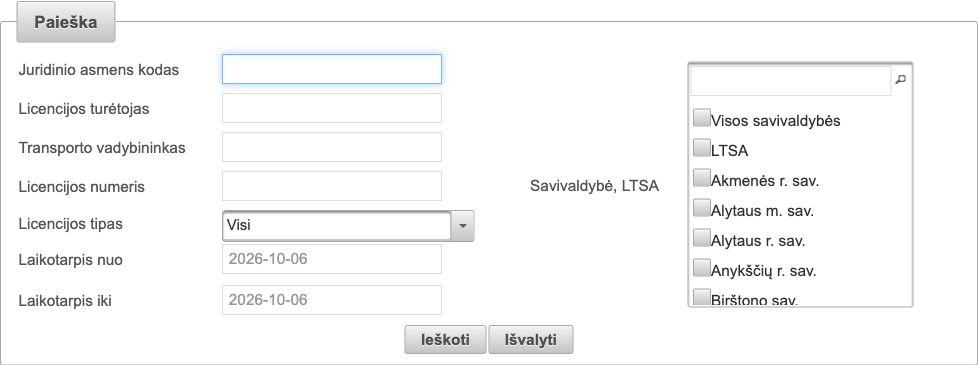
In LTSA Vektra, start with Juridinio asmens kodas. Compare the holder, document category, status and validity dates with the booking. A passenger licence or a licence limited to lighter vehicles does not establish authorisation for a heavy goods combination.
Labels such as EBKR, EBN1 and SL help identify documents, but read the full description. Confirm goods carriage, the relevant mass and route, and validity throughout the haul. If dates or scope cannot be read, request the document rather than assuming compliance.
A missing transport manager name in a public result does not establish failure to meet licensing requirements. A valid operator licence also does not automatically confirm the document for a specific vehicle. For detailed register navigation, use our LTSA walkthrough.
6. Check the vehicle and identify the actual operator
When a plate is available, compare the certified copy status, scope and associated operator. Compare the company attached to the vehicle document with the identified operator. Clarify it before loading; the difference alone is not evidence of fraud.
If another operator is shown, identify the subcontractor, verify its authorisations and confirm approval of subcontracting. Compare the operator with the documents and insurance. An unreadable vehicle record is different from a confirmed document associated with another company.
Forwarding itself does not require a Lithuanian carrier licence, as explained in LTSA’s FAQ. Establish who performs the haul. A company’s registered activity does not prove its role in a particular booking.
For a vehicle combination, the certified Community licence copy stays in the motor vehicle and covers the combination, including a trailer registered to another party or in another country. See Article 4(4) of Regulation 1072/2009. Assess trailer documents and insurance separately.
7. Separate motor insurance from carrier liability insurance
CAB is the Lithuanian motor insurers’ bureau. Confirming compulsory motor insurance does not establish the scope of carrier liability cover for the goods. A policy described as CMR insurance still needs its wording checked; the label does not determine its cover.
How to match the policy to the booking
Match the insured party to the actual operator, cover dates to the haul, territory to the route and goods cover to the cargo. Read the sum insured, sublimits, deductible, exclusions and vehicle or subcontracting conditions. Keep the policy, wording and endorsements. Obtain insurer confirmation when a material point is unclear.
8. Interpret financial and employment data with their dates
Basic public JAR search is not a complete view of finances or employment. Additional financial and SODRA data obtained through JARS.lt has a separate source and scope. Do not attribute all this information to the free JAR search screen.
Last year’s accounts do not show current bank balances or liquidity. Check the reporting period for employment and debt data. Missing information is not zero, and a small workforce does not establish unreliability. Consider the operating model and subcontracting, and clarify material inconsistencies with the company.
9. Confirm the contact independently of the incoming email
Compare domain spelling with the company’s established channels. Confirm changes to bank details, phone, operator or plates through a number obtained independently of the new message. Domain age can justify a question but is not evidence of impersonation. Domain registration data does not confirm the sender’s location or match it to the company address.
Example: the licence fits, but the vehicle belongs to another operator’s record
Illustrative example, not a finding about a specific company. A booking is for a heavy goods combination from Lithuania to Poland. Company details match and the licence category fits. The vehicle document points to another entity, and the contact confirms subcontracting.
Before loading, obtain the subcontractor’s code, check its authorisations and vehicle document, and compare insurance with the actual operator. Record subcontracting approval. Verifying the company that sent the offer does not complete verification of the haul.
What should you do with a confirmation, mismatch or missing result?
A report’s risk assessment supports a business decision. It is not a legal ruling or a finding of fraud.
| Outcome | Meaning | Next action |
|---|---|---|
| Confirmed | A source confirmed a specific item | Check the remaining items and retain evidence |
| Mismatch | Details or scope do not fit the booking | Clarify and recheck before loading |
| Missing data or unavailable source | The check is inconclusive | Obtain documentation or repeat the check; do not treat it as a pass |
| Requirement does not apply | A specific threshold or exemption applies | Record the basis, mass and type of carriage |
Checklist before loading
- Identify the contractual party and the operator performing the haul.
- Match authorisation to maximum authorised mass, route and dates.
- Compare plates and the appropriate vehicle document.
- Check motor insurance and carrier liability cover separately.
- Clarify mismatches and subcontracting through an independent contact.
- Save dated results, sources, documents and explanations with the booking. Recheck relevant items if the vehicle or operator changes.
Repeat the same process for your next booking
Certica collects Lithuanian company, VAT and licence data, with available vehicle information when you provide a plate. The report helps identify inconsistencies and missing confirmations before assigning a load.
- Company details and authorisations in one place.
- Available vehicle information when plates are known.
- A risk assessment to support your decision and record the check.
Certica
Don't want to do this on every booking?
Certica pulls data from the same registers, checks it, and shows a clear result: what is OK, and what needs clarifying before loading.
Compare the operator with the vehicle document
Certica can compare the checked company with the entity attached to the vehicle document in Lithuanian data. A different entity requires clarification of the operator and subcontracting; an unreadable source is a separate, inconclusive outcome. Additional financial and SODRA data in the report is supplied through JARS.lt.
Official sources
- Registrų centras: public JAR searchhttps://www.registrucentras.lt/jar/p/index.php
- Registrų centras: scope of free datahttps://info.registrucentras.lt/content/144427
- LTSA Vektra: carriers and licenceshttps://vektra.eltsa.lt/vektra-portal/web/viesoji-sritis/vezejai-ir-licencijos
- LTSA: licensing requirementshttps://ltsa.lrv.lt/lt/veiklos-sritys/keliu-transportas-5/kroviniu-vezimas-2/licencijavimas/
- LTSA: frequently asked questionshttps://ltsa.lrv.lt/lt/duk/
- CAB: Lithuanian motor insurers’ bureauhttps://www.cab.lt/en/
- European Commission: VIEShttps://ec.europa.eu/taxation_customs/vies/
- Regulation 1072/2009: goods carriage, certified copies and cabotagehttps://eur-lex.europa.eu/legal-content/EN/TXT/?uri=CELEX:02009R1072-20220221
FAQ
Does a Lithuanian van up to 3.5 tonnes need a licence?
For international goods carriage for hire or reward over 2.5 tonnes up to 3.5 tonnes, the appropriate Community licence and certified copy are required. The same licensing obligation does not apply to ordinary domestic goods carriage in Lithuania in that mass category. Assess exemptions and own-account transport separately.
Does a Lithuanian freight forwarder need a carrier licence?
Forwarding itself does not require this licence. If the company arranges the haul, identify and verify the actual operator. If it performs the haul, assess the requirements using the mass and route.
What if LTSA associates the vehicle with another company?
Identify the operator and clarify subcontracting. Check that company, the vehicle document and insurance. The mismatch alone does not establish fraud.
Are financial and SODRA data included in free JAR search?
Basic JAR search provides identification and legal status information. Detailed information and extracts have separate access conditions. Additional financial and SODRA data obtained through JARS.lt has a separate source and scope.
Does a missing transport manager name mean there is no valid authorisation?
A missing name in the public result is not enough for that conclusion. Check the appropriate licence, status and scope, then clarify missing information with the carrier or LTSA.
Does valid motor insurance confirm cover for the goods?
No. Compulsory motor insurance and carrier liability cover are separate checks. Compare the liability policy with the actual operator, route, dates, goods and booking conditions.