
Polish registries · 8 min read
KREPTD search: check a Polish transport licence by NIP
To check a Polish transport licence, search the carrier’s NIP in the public KREPTD register. Match the operator, read the relevant goods authorisation and Community licence, and compare their status and dates with your booking. This guide explains the Polish labels and screenshots. Company existence alone is not carrier verification.
Looking for a KREPTD login to manage your own licence? Open kreptd.gitd.gov.pl. This guide is for a forwarder checking a Polish carrier before a load.
Before opening the register
Get the operator’s legal name, ten-digit Polish tax number (NIP), licence document, route, transport dates and permitted laden mass of the vehicle or combination. Use the company you will actually hire to perform the haul. If a forwarder has arranged a subcontractor, establish the subcontractor’s identity as well.
KREPTD is the National Electronic Register of Road Transport Operators, maintained by GITD. Its public search is free. A Polish VAT number adds PL to the NIP; enter the ten digits in the NIP field. KRS and REGON numbers are different identifiers.
1. Search by NIP and open the right operator
Open KREPTD and enter the NIP from your contracting details. Complete the security check requested by the portal, then press Szukaj, meaning Search. Compare Firma przedsiębiorcy, the business name, and NIP with the order. Numer referencyjny identifies the register entry; it is not the licence number.
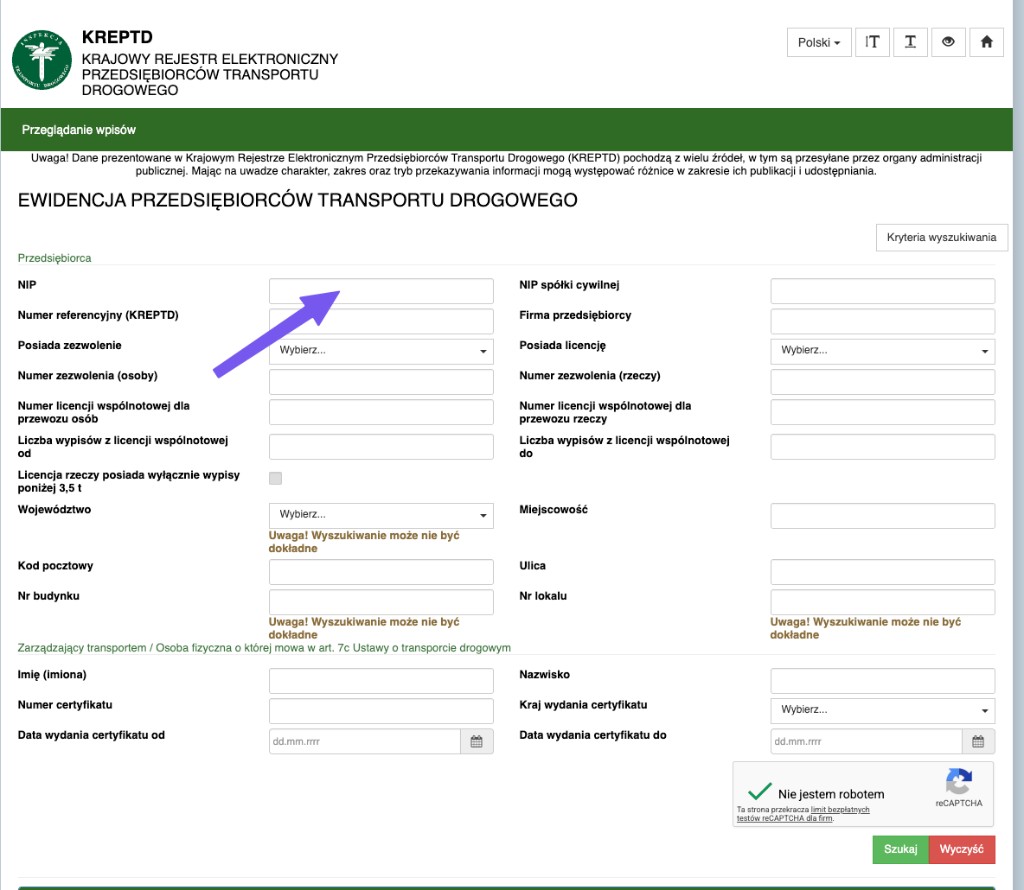
What to look at: Enter the ten-digit Polish NIP in the tax-number field. Unnecessary filters can restrict the result.
Next: Search, match the company and NIP, then open its details.
Open screenshot in full size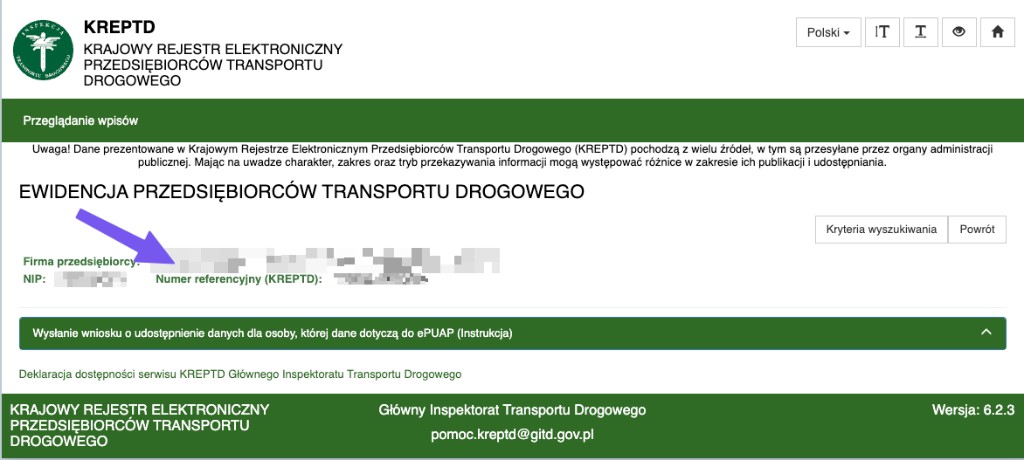
What to look at: Match the legal entity and tax number. A similar name is not enough. These screenshots illustrate the interface, not a current approval of the businesses shown.
Next: Read the goods authorisation and licence in the matching entry.
Open screenshot in full sizeIf you cannot find the company
Recheck the NIP and filters and confirm that the carrier is Polish. A foreign operator belongs in its issuing country’s register. If a correct search remains unresolved, ask for current authorisation details and seek clarification from GITD. An unavailable portal, a wrong identifier and a confirmed lack of required authorisation are different findings.
2. Read the authorisation required for your haul
For goods transport, look for Zezwolenie na wykonywanie zawodu przewoźnika drogowego w zakresie rzeczy, the authorisation to pursue the occupation of road haulage operator. For ordinary licensed international EU goods transport, also inspect Licencja wspólnotowa na przewóz rzeczy, the Community goods licence. A passenger-transport entry does not answer a goods booking.
Read Numer zezwolenia or Numer licencji, then Status and the validity dates. Ważne means Valid. Początek ważności and Koniec ważności are the start and end of validity. Check the live status as well as the dates: a future expiry on an old scan does not establish that an authorisation remains active.
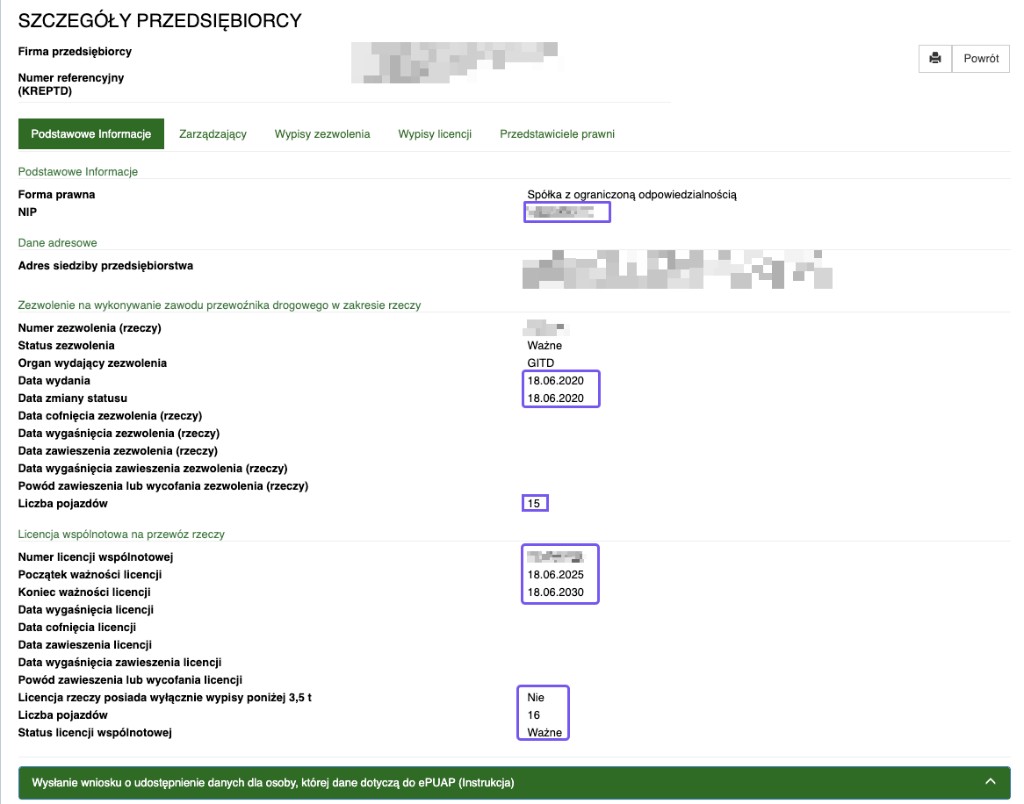
What to look at: Read each document’s type, number, status and dates separately. The vehicle counts relate to the displayed authorisation or licence.
Next: Compare the licence number with the carrier’s document and the validity period with your transport dates.
Open screenshot in full sizeA van is not automatically exempt
For international EU goods carriage for hire or reward, the Community-licence requirement generally applies above 2.5 tonnes permitted laden mass, including the combination. Domestic operations and the exemptions in Article 1(5) of Regulation 1072/2009 need separate consideration. Ask for the operation and vehicle mass before interpreting a missing licence.
3. Understand the vehicle count and certified copy
Liczba pojazdów means number of vehicles. It is register information, not a promise that a truck is available, proof of ownership, or a plate match. A small fleet can be legitimate. Zero or an unexplained discrepancy is a reason to ask for current details, rather than to infer fraud from the number alone.
The label Licencja rzeczy posiada wyłącznie wypisy poniżej 3,5 t indicates that the goods licence has only copies for vehicles below 3.5 tonnes. Clarify this if a heavy combination is offered. A wypis is a certified copy of the authorisation or licence. Compare the copy’s holder and document number with the operator record and ask for the copy relevant to the motor vehicle doing the haul.
The public KREPTD company search does not confirm a particular truck by registration plate. Under Article 4 of Regulation 1072/2009, the certified copy accompanies the motor vehicle and covers the coupled combination. A trailer registered to a different entity or in another country does not by itself invalidate that copy.
4. Read contradictory statuses before relying on the entry
Data cofnięcia means revocation date, Data wygaśnięcia means expiry or termination date, and Data zawieszenia means suspension date. Read these together with the current status and the transport dates. A contradictory or unclear record needs clarification from the operator or issuing authority; colour alone is not a decision rule.
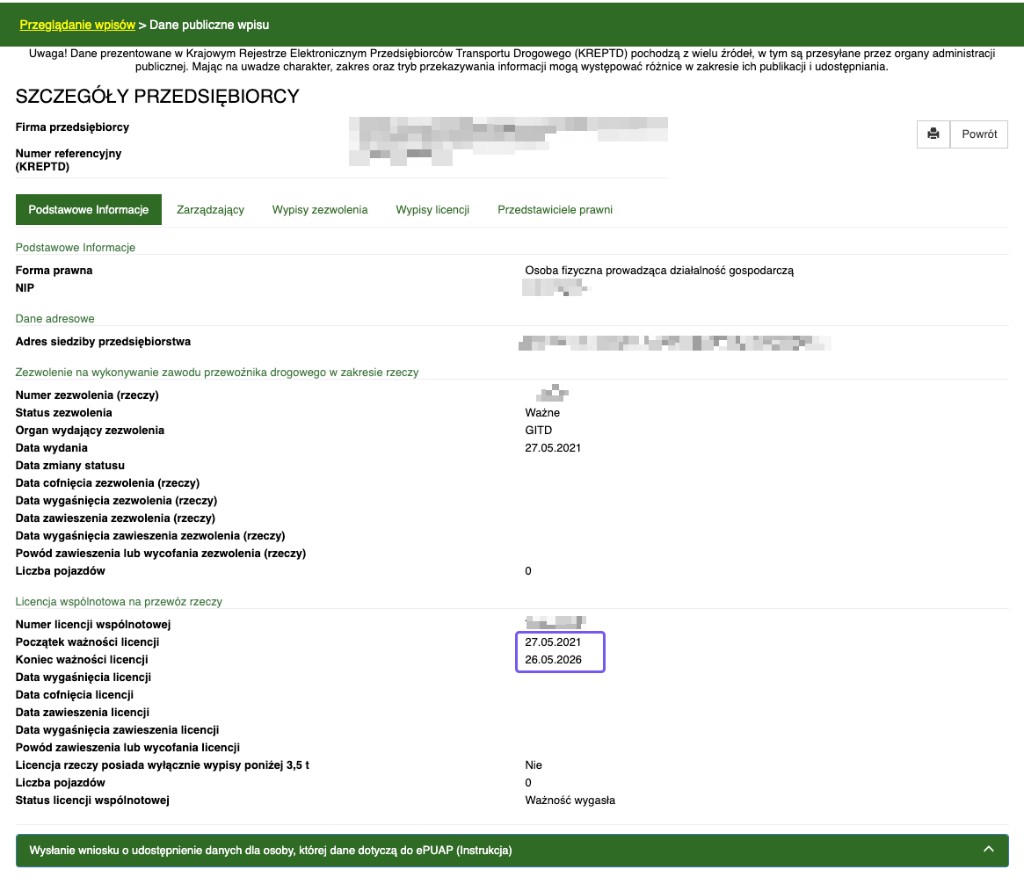
What to look at: Ważność wygasła means validity has expired. The company entry still exists, but this displayed licence is not current.
Next: Obtain and verify current authorisation before assigning a haul that requires this licence. An old PDF does not resolve an expired live status.
Open screenshot in full sizeFor example, an operator may have an active goods authorisation while its displayed Community licence has expired. The first entry does not repair the second. Check the document needed for the planned operation. This is an interpretation example, not a finding about a named carrier.
The Zarządzający tab identifies transport managers where published. This is a professional role, not necessarily the driver, owner or dispatcher. A missing public manager name does not by itself establish a breach of licensing requirements.
What to keep, and what to check next
Save the NIP, operator name, authorisation and licence numbers, status, relevant dates and check date with the order. Keep unresolved discrepancies and the explanation you obtained. A register screenshot documents what you saw at that time; it does not guarantee later status or identify the person using the carrier’s email.
Continue with the Polish carrier verification guide for company, contact and insurance checks. A transport licence does not confirm the cargo cover in a carrier liability policy. For another issuing country, use the European transport-register guide.
Certica
Don’t want to do this by hand?
Certica brings the Polish licence check together with supported company, VAT, vehicle and contact checks in the app. You can also analyse the carrier’s policy against your planned transport.
No card required. Most checks complete in 10-40 seconds, depending on the country and registry availability. Some registries may take longer when official services are slow or unavailable.
Official sources and licensing scope
The interface examples come from the public KREPTD register. GITD explains the register and its public scope on its official KREPTD information page.
Community-licence scope and exemptions are in Article 1 of Regulation 1072/2009; Article 4 covers the licence and certified copies. GITD’s goods-transport licensing documents include the 2.5-to-3.5-tonne vehicle category. For cabotage or a route outside the EU, establish the additional requirements for that operation.
FAQ: checking a Polish transport licence
Can I check a Polish carrier by registration plate in KREPTD?
The public company search does not identify a booked truck by plate. Search the operator by NIP and compare its licence details with the certified copy supplied for the motor vehicle. Vehicle insurance is a separate check.
Does a company in KRS or CEIDG automatically have haulage rights?
No. Company registration and road-transport authorisation answer different questions. Establish which permit the operation requires and check that authorisation in KREPTD.
What if the NIP returns no result?
Check the ten-digit Polish NIP, spelling and search filters, and confirm that the operator is established in Poland. If the result remains unresolved, request the current authorisation and obtain clarification from GITD. A portal error is not proof that a licence is missing.
Do international vans also need a Community licence?
For ordinary international EU goods carriage for hire or reward, the requirement generally applies above 2.5 tonnes permitted laden mass, including the combination. Article 1(5) of Regulation 1072/2009 provides exemptions. Do not apply the heavy-truck rules to every van or own-account operation without checking its scope.
Does a trailer need its own Community-licence copy?
Under Article 4 of Regulation 1072/2009, the certified copy accompanies the motor vehicle and covers the coupled combination. A different trailer registration is not by itself evidence that the tractor licence copy is invalid.