
Carrier liability policies · 9 min read
How to check a Generali carrier liability policy
On a Generali carrier liability policy, match “Ubezpieczony” (insured) to the booking, write down “Numer” next to the word Polisa (not “Nr Umowy Generalnej”, the master agreement number) and check that “Okres ubezpieczenia” (period of cover) spans the whole haul. Territory sits on page 1, the sum on page 2, and cargo is in “Klauzula wyłączeń grup towarowych” (cargo-group exclusion clause) plus clauses 30 and 31. Confirm the number on portal.generali.pl.
This is an independent Certica tutorial. It was not written or approved by Generali. The document shown is not a live insurance policy.
What the document can confirm, and what it cannot
Check a Generali policy in two stages. First read the document and compare it with the booking. If the rate, the cargo or the file looks wrong, confirm the number on Generali’s page for checking the status of a carrier liability policy.
The screenshots are a Polish Generali form. Match the printed labels. Each Polish field name in this walkthrough is followed by the English meaning in brackets.
Carrier liability insurance covers liability for goods in transit. On a Generali form the title is “OC Przewoźnika Drogowego” (road carrier liability). It is not vehicle MTPL. Check tractor and trailer MTPL separately in UFG. A company record in KRS or CEIDG is not carrier verification.
What the first page of a Generali policy looks like
Numbers 1 to 5 on the graphic are the product, the insured, the number and period, the territory and the subject of insurance. The sum sits on page 2. The exclusion list and cabotage with DMC and plates sit in the additional clauses. Step 7 is confirmation outside the document. The printed labels are in Polish. Each step quotes those words and gives the English meaning in brackets.
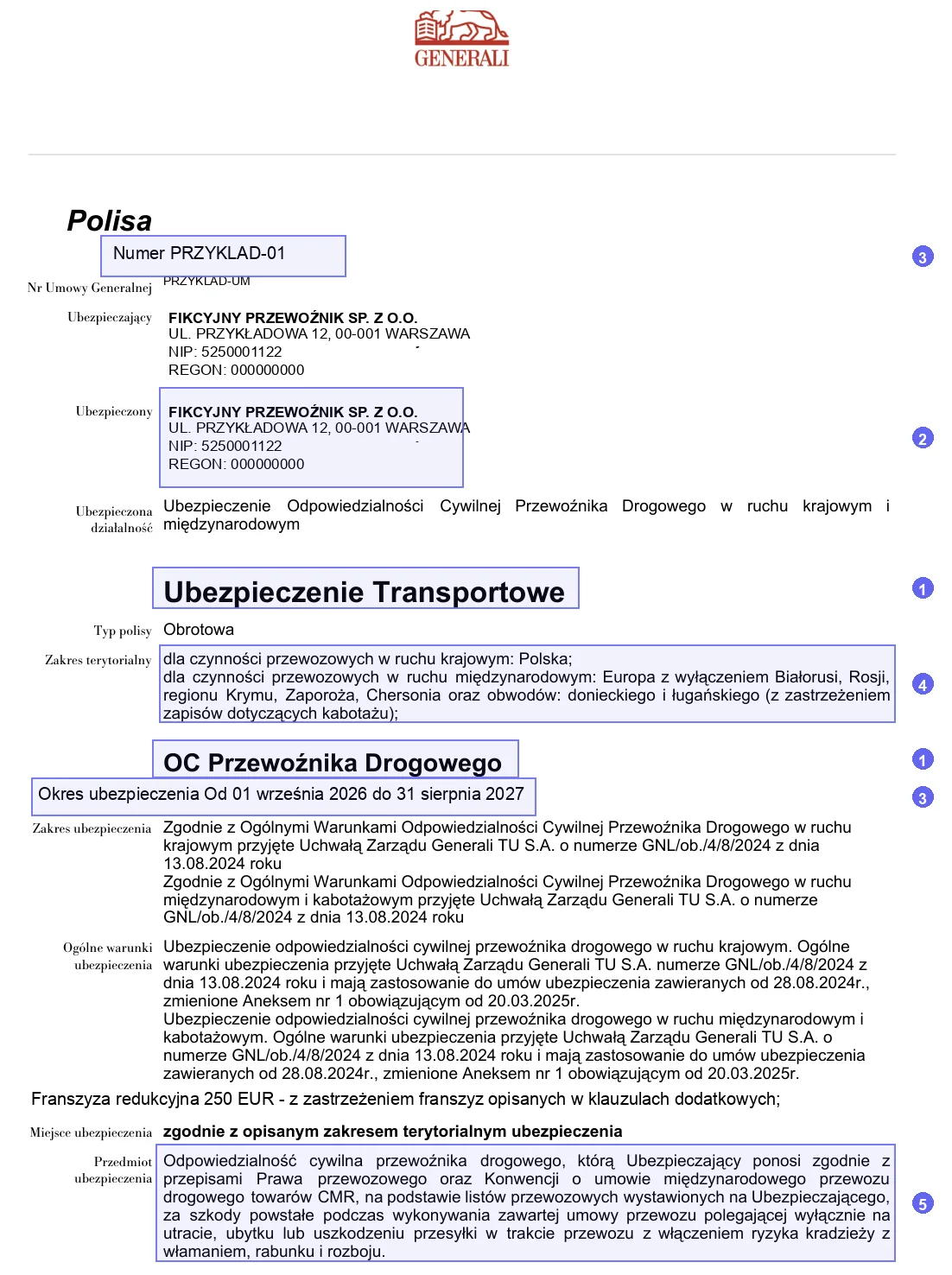
How to check a Generali carrier liability policy step by step
Step 1. Subject of insurance
On the first page find “Ubezpieczenie Transportowe” (transport insurance) and the title “OC Przewoźnika Drogowego” (road carrier liability). That is the Generali product. “Ubezpieczona działalność” (insured activity) repeats the same domestic and international scope.
Do not mix this policy with professional carrier cover for the licence requirement. Carrier liability insurance covers liability for the goods. A title “Ubezpieczenie Odpowiedzialności Cywilnej Spedytora z rozszerzeniem o ubezpieczenie Odpowiedzialności Cywilnej Przewoźnika Drogowego Umownego” (freight-forwarder liability with an extension for a contractual road carrier) is a different product. If the company will haul as the actual carrier, do not accept forwarder cover alone.
Step 2. Insured party
Find “Ubezpieczający” (policyholder) and “Ubezpieczony” (insured). For the haul the insured is the key field. Compare the full legal name, legal form, NIP, REGON and address with the contract and the current company record.
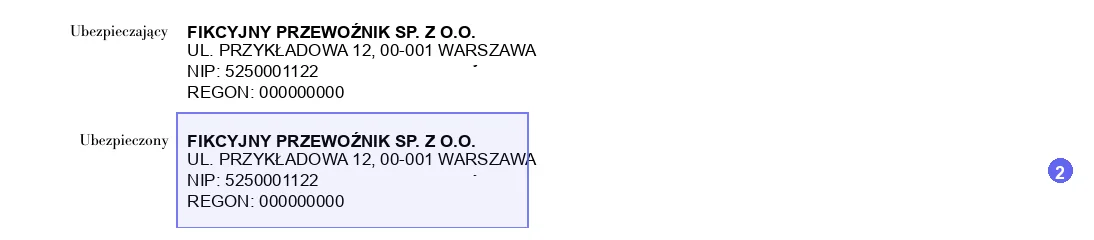
Watch this
A similar trading name is not enough. A policy issued to the owner, another group company or an older business needs an explanation before loading.
Step 3. Number and period
Write down “Numer” (policy number) exactly as it sits next to the word Polisa. Next to it sits “Nr Umowy Generalnej” (master-agreement number). That is not the policy number. The dates in “Okres ubezpieczenia” (period of insurance) must cover loading, the trip and the planned unloading. The same crop also shows “Zakres terytorialny” (territorial scope). Read those three rows in step 4.
“Typ polisy” (policy type) on the Generali form reads “Obrotowa” (turnover policy). That is a turnover contract, not a single-trip policy.
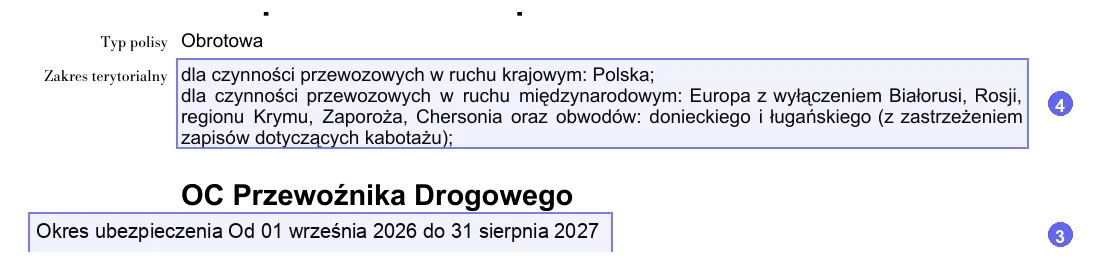
Step 4. Sum, territory and deductible
Find the sum on page 2 in “Suma ubezpieczenia” (sum insured). Generali prints one amount “na każde zdarzenie” (per event). Do not copy that sum onto German cabotage.
Territory sits on the first page in “Zakres terytorialny” (territorial scope). Read three rows: domestic Poland, international Europe with the exclusion list, and the cabotage reservation. In “Franszyza redukcyjna” (deductible) read the amount and the note “z zastrzeżeniem franszyz opisanych w klauzulach dodatkowych” (subject to deductibles in the additional clauses).

Step 5. Cargo and clauses
Under “Klauzule dodatkowe” (additional clauses) open “Klauzula wyłączeń grup towarowych” (cargo-group exclusion clause). The sentence starts with “z wyłączeniem” (excluding). That is an exclusion list, not a stamp for every cargo.
The list includes damaged and post-accident vehicles, live animals, people, postal and courier consignments outside CMR or Polish transport law, household removals, coal, ADR classes I and VII, cash, securities, collections, precious and semi-precious metals and stones, military goods, weapons and ammunition. Copper, chromium, nickel and aluminium are often taken out of that metal exclusion. A high sum on page 2 does not cover a line on this list unless a numbered clause was bought.
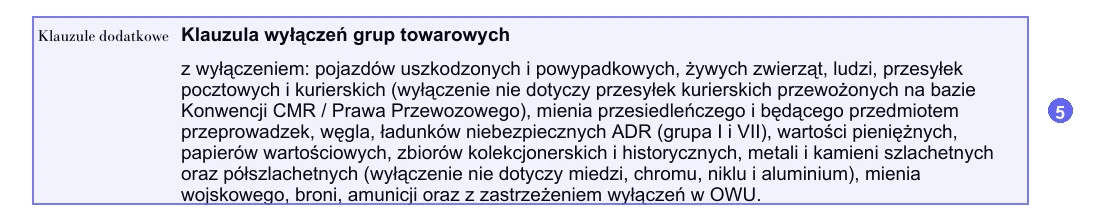
Watch this
Temperature-controlled medicines, alcohol above 15%, tobacco, new vehicles and a reefer breakdown have their own numbered clauses. The clause name on the form is not enough. Check the mark, the sublimit and the deductible.
Step 6. Vehicles and cabotage
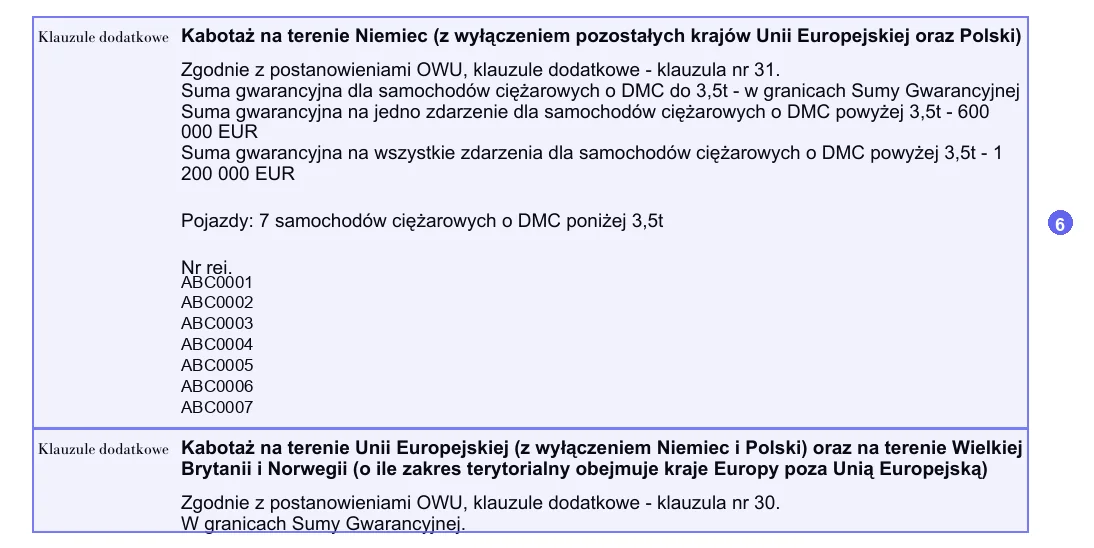
A plate list on a Generali policy does not sit on the first page. Find it under “Klauzule dodatkowe” (additional clauses) at “Kabotaż na terenie Niemiec” (cabotage in Germany), “klauzula nr 31” (clause no. 31).
Read DMC up to 3.5 t and DMC above 3.5 t as separate rows. The policy may limit cover to a stated number of “samochodów ciężarowych o DMC poniżej 3,5t” (goods vehicles under 3.5 t GVW) and a “Nr rej.” (registration no.) list. A tractor or combination from the booking that is not on that list is outside this wording.
Step 7. Official confirmation
Generali has a public page for checking the status of a carrier liability policy on portal.generali.pl. Open that page yourself. Type the policy number. The system shows whether the policy is active and paid to schedule, or a message that it cannot verify the data. There is also a “Weryfikuj PDF” (verify PDF) button.
Do not use a phone number that appears only in the carrier’s email. On the first page check both sets of OWU: domestic road-carrier liability and international plus cabotage, resolution GNL/ob./4/8/2024. Missing pages with clauses 30 and 31 change the cabotage reading.
Limits most often missed on Generali policies
Clause 31 and clause 30 are two different cabotage covers
“Klauzula nr 31” (clause no. 31) is “Kabotaż na terenie Niemiec (z wyłączeniem pozostałych krajów Unii Europejskiej oraz Polski)” (cabotage in Germany, excluding the other EU countries and Poland). “Klauzula nr 30” (clause no. 30) is cabotage in the EU without Germany and Poland and, if the territory allows it, in the United Kingdom and Norway.
No clause 31 means no German cabotage. The sum on page 2 does not buy that scope. In clause 31 read the separate sums for DMC up to 3.5 t and above 3.5 t, plus the plate list.
The cargo-group exclusion clause matters more than a high sum
“Przedmiot ubezpieczenia” (subject of insurance) can read broadly. “Klauzula wyłączeń grup towarowych” (cargo-group exclusion clause) decides the cargo. ADR classes I and VII, coal, live animals, cash and post-accident vehicles fall out unless a numbered clause with a sublimit and a deductible is present.
Europe on the form excludes Belarus, Russia and named Ukrainian regions
The international row reads “Europa z wyłączeniem Białorusi, Rosji, regionu Krymu, Zaporoża, Chersonia oraz obwodów: donieckiego i ługańskiego” (Europe excluding Belarus, Russia, Crimea, Zaporizhzhia, Kherson and the Donetsk and Luhansk regions). Some policies also name Moldova. A route through those places does not sit under the Europe heading. Compare loading and unloading points with that sentence, not with an EU map.
The subject clause covers loss, shortage or damage of the consignment
In “Przedmiot ubezpieczenia” (subject of insurance) Generali writes about damage “polegającej wyłącznie na utracie, ubytku lub uszkodzeniu przesyłki” (consisting solely of loss, shortage or damage of the consignment). Delay, delivery to the wrong person, a financial loss or a reefer breakdown need their own clause. Theft with break-in, robbery and hold-up are added in that paragraph. The other risks are not.
A sublimit can be for one event and for all events
On the additional clauses look for “na jedno i wszystkie zdarzenia” (for one event and for all events). That limit shrinks after a payout. A PDF from the start of the period does not show how much limit is left. On clause 31 the all-events sum for DMC above 3.5 t is often different from the one-event sum.
Two OWU documents and a forwarder product are not a full carrier policy
The first page cites two documents: OWU for domestic road-carrier liability and OWU for international and cabotage liability, both resolution GNL/ob./4/8/2024 with annex no. 1. One OWU does not cover both scopes.
A document titled as freight-forwarder liability with an extension for a contractual carrier is not a full carrier liability policy. Read the title before you compare the sum.
How to decide after you have read the policy
| Check result | What it means | Next step |
|---|---|---|
| Name, dates, route, sum and the exclusion list match the booking | The document fits the planned haul | Record the result and finish the other carrier checks |
| A different name, NIP or REGON in Ubezpieczony | The policy may belong to another party | Hold the decision and ask for an explanation or the right document |
| The period ends before unloading | The document does not cover the whole planned haul | Ask for a renewal and confirmation before loading |
| The cargo is on the cargo-group exclusion list and the needed clause is missing | There is no basis to accept that scope | Read the full policy or get Generali confirmation |
| The sum on page 2 is high, but clause 31 is missing or the plate is not on the list | Real cover for German cabotage or that vehicle may be too thin | Compare clauses 30 and 31 and the DMC class with the cargo value and escalate |
| You received only the first page or a forwarder document with contractual-carrier wording | The file is incomplete or it is a different product | Ask for the full carrier liability policy and confirm it on portal.generali.pl |
What a PDF check does not confirm
How to read a Generali policy is a different question from how to confirm that it is still current. The document lets you judge the declared scope. It does not open the live contract state in the insurer’s system.
- The PDF can be old, altered or incomplete.
- A signature and a logo do not prove authenticity on their own.
- A paid premium does not prove that the scope was not changed later.
- Carrier liability does not confirm vehicle MTPL, a transport licence, VAT or company status.
- A final view on whether the cover is adequate may need a broker, the insurer or a lawyer.
Keep this in mind
The PDF alone does not prove that the contract was not later changed, cancelled or limited by an annex.
Don’t want to analyse every policy by hand?
Certica analyses the uploaded carrier liability policy in any language. It reads the insured party, the period, the document type, territorial scopes, sums and the named cargo categories.
Official sources
- Generali: carrier liability policy status checkhttps://portal.generali.pl/corpoplus/weryfikacja-polisy-ocp.html
- Generali: home pagehttps://www.generali.pl
- Generali: client zonehttps://www.generali.pl/strefa-klienta
- Generali: professional road-carrier liability press notehttps://media.generali.pl/informacje-prasowe/864378/nowosc-w-produkcie-odpowiedzialnosci-cywilnej-zawodowej-przewoznika-drogowego-2026-02-06
FAQ
Can you check a Generali carrier liability policy by number online?
Yes. Generali has a page for checking the status of a carrier liability policy on portal.generali.pl. Type the policy number. The system shows whether the policy is active and paid, or a message that it cannot verify the data. There is also a “Weryfikuj PDF” (verify PDF) option.
Is a Generali carrier liability policy the same as vehicle MTPL?
No. Carrier liability covers the haulier’s liability for the goods and the transport. Vehicle MTPL is compulsory motor insurance. For Polish plates check it separately in UFG.
Where is the sum insured on a Generali policy?
In “Suma ubezpieczenia” (sum insured), usually on page 2. Generali prints one amount per event. German cabotage has separate sums in “klauzula nr 31” (clause no. 31), split by DMC.
Which Generali dates should you compare with the booking?
The dates in “Okres ubezpieczenia” (period of insurance) must cover the whole haul: loading, the trip and the planned unloading. Validity on the delivery day alone is not enough.
Does the Generali online check replace reading the clauses?
No. The page on portal.generali.pl confirms that the policy is active and paid. It does not show “Klauzula wyłączeń grup towarowych” (cargo-group exclusion clause), clauses 30 and 31 or the plate list. For cargo and route you need the full policy.
What should you check on a Generali policy before German cabotage?
Check that “klauzula nr 31” (clause no. 31) “Kabotaż na terenie Niemiec” (cabotage in Germany) is present, that the sums and DMC classes are split, and that the booking plate sits under “Nr rej.” (registration no.). Then confirm the number on portal.generali.pl.
How does cargo liability cover differ from professional carrier cover?
Carrier liability insurance covers liability for the goods. Professional road-carrier liability cover serves the licence requirement. Generali’s press note on remote conclusion concerns that product rather than cargo liability insurance.
Related pages
Knowledge base
- Carrier liability policies by insurer
- Knowledge base
- How to verify a carrier
- Is freight exchange verification enough
- Carrier documents checklist
- Carrier vetting process
- Manual vs automated carrier verification
- Carrier liability insurance check
- UFG vehicle insurance Poland
- How to check a Compensa carrier liability policy