
Carrier liability policies · 9 min read
How to check a Compensa carrier liability policy
On a Compensa carrier liability contract, match the party marked “zwanym dalej Ubezpieczonym” (hereinafter the insured) to the booking and read the period in § 13. The single “Suma ubezpieczenia” (sum insured) is in § 4, territory in § 13(2), the cargo exclusion list in § 2(4), and German cabotage in a separate annex. A BAG certificate is not this contract; confirm it on Compensa’s form.
This is an independent Certica tutorial. It was not written or approved by Compensa. The document shown is not a live insurance policy.
What the document can confirm, and what it cannot
Check a Compensa contract in two stages. First read the full document and compare it with the booking. If the rate, the cargo or the file looks wrong, confirm the contract on Compensa’s official form “Potwierdzenie zawarcia umowy OC przewoźnika” (confirmation of a carrier liability contract).
The screenshots are a Polish Compensa contract. Match the printed labels. Each Polish field name in this walkthrough is followed by the English meaning in brackets.
Carrier liability insurance covers liability for goods in transit. On a Compensa form the title is “Umowa ubezpieczenia odpowiedzialności cywilnej przewoźnika drogowego” (road carrier liability insurance contract). It is not vehicle MTPL. Check tractor and trailer MTPL separately in UFG. A company record in KRS or CEIDG is not carrier verification.
What the first page of a Compensa policy looks like
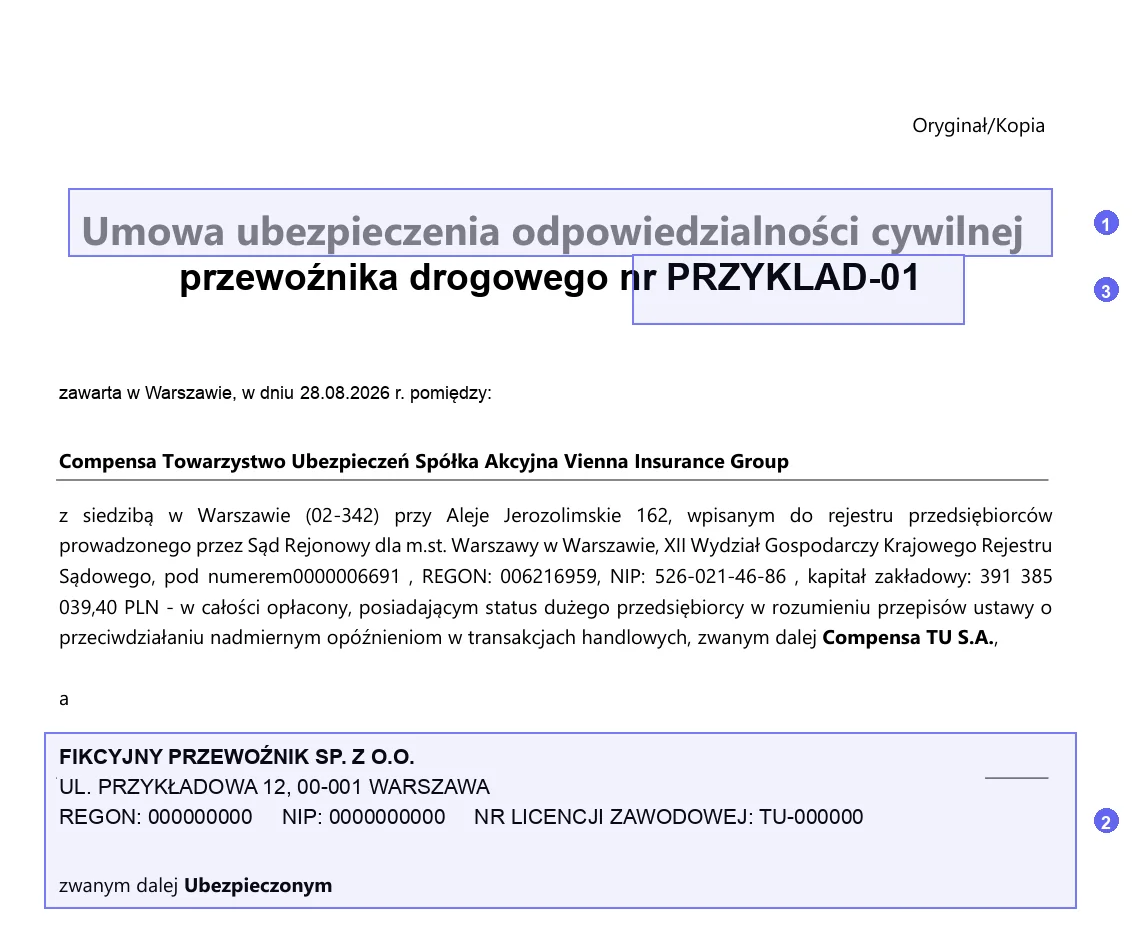
Numbers 1, 2 and 3 on the graphic are the title, the insured and the contract number. Step 3 (the period) and step 4 (the sum and territory) sit in “§ 13” and “§ 4”, later in the document. Step 5 is the DMC limit in the “Kabotaż Niemcy” (German cabotage) annex. Step 6 is the exclusion list in “§ 2 ust. 4”. Step 7 is confirmation outside the document. The standard Compensa contract does not list registration plates. The printed labels are in Polish. Each step quotes those words and gives the English meaning in brackets.
How to check a Compensa carrier liability policy step by step
Step 1. Subject of insurance
On the first page find the title “Umowa ubezpieczenia odpowiedzialności cywilnej przewoźnika drogowego” (road carrier liability insurance contract). That is the Compensa product.
Above the title sits “Product_CODE: 140012001, 140012002”. Those are product codes, not the contract number. The German cabotage annex has its own code 140012003.
Step 2. Insured party
Under the Compensa block find the other party labelled “zwanym dalej Ubezpieczonym” (hereinafter the insured). Compare the full legal name, legal form, REGON, NIP, address and “NR LICENCJI ZAWODOWEJ” (professional licence number) with the booking and the current company record.

Watch this
Some Compensa contracts list several insured parties under one number. A contract issued to a sister company, the owner or a former business needs an explanation before loading.
Step 3. Contract number and period
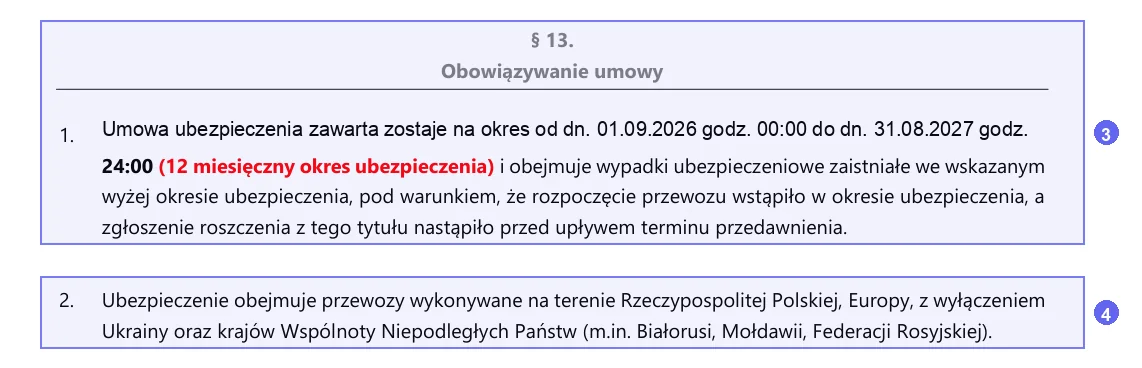
Write down the number in the title after “przewoźnika drogowego nr” (road carrier contract no.). Then open “§ 13. Obowiązywanie umowy” (term of the contract). Read “Umowa ubezpieczenia zawarta zostaje na okres od dn.” (the insurance contract is concluded for the period from) with the start at 00:00 and the end at 24:00.
The dates must cover loading, transit and the planned unloading. Compensa adds a condition: “pod warunkiem, że rozpoczęcie przewozu wstąpiło w okresie ubezpieczenia” (provided that the haul started during the period of cover). A haul that started before the period stays out, even if unloading is still inside the dates.
Step 4. Sum, territory and deductible
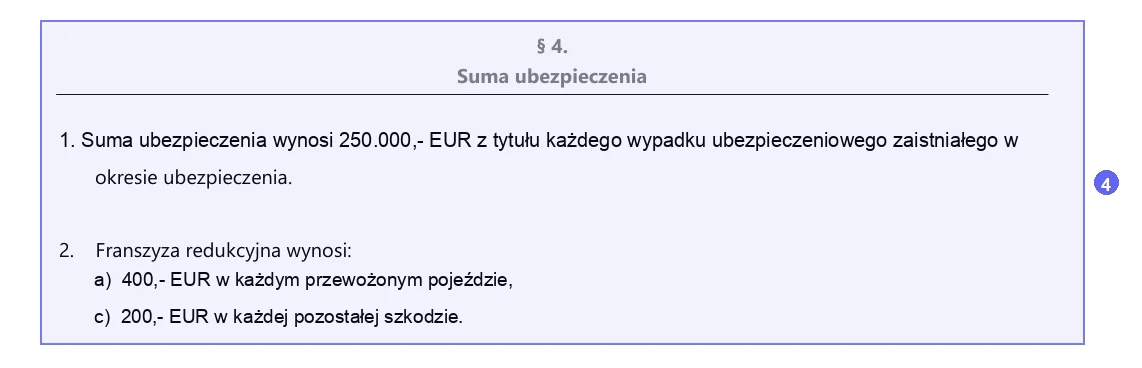
In “§ 4. Suma ubezpieczenia” (sum insured) Compensa prints one figure “z tytułu każdego wypadku ubezpieczeniowego” (for each insured event). There are no three blocks as on other forms. Do not copy that sum onto German cabotage.
Territory sits in § 13(2): “Rzeczypospolitej Polskiej, Europy, z wyłączeniem Ukrainy oraz krajów Wspólnoty Niepodległych Państw” (Poland and Europe, excluding Ukraine and the CIS). In § 4 also read “Franszyza redukcyjna” (deductible). On the contract it is often split: a higher figure “w każdym przewożonym pojeździe” (for each vehicle carried) and a lower figure “w każdej pozostałej szkodzie” (for every other loss).
Step 5. Vehicles and DMC
The standard Compensa contract does not list registration plates. Do not look for a plate annex on the first page.
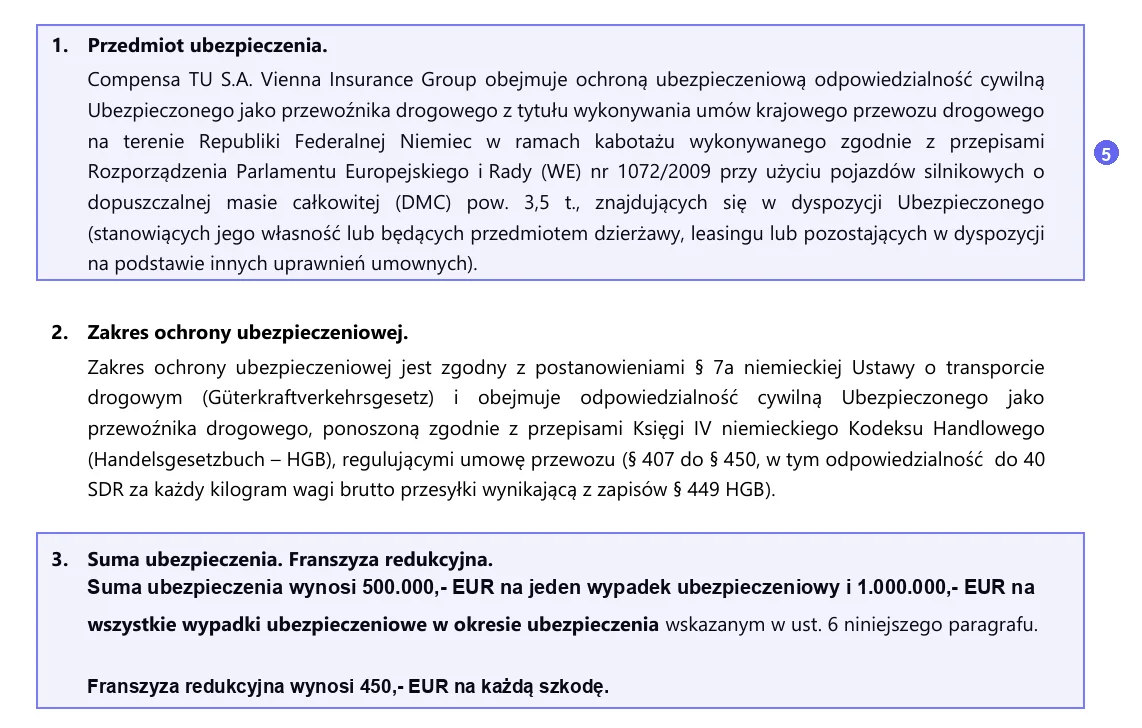
The vehicle limit appears in the annex “Kabotaż Niemcy” (German cabotage): cover applies to “pojazdów silnikowych o dopuszczalnej masie całkowitej (DMC) pow. 3,5 t.” (motor vehicles with GVW over 3.5 t). A booked tractor or combination below that threshold is outside this annex.
Step 6. Cargo exclusions
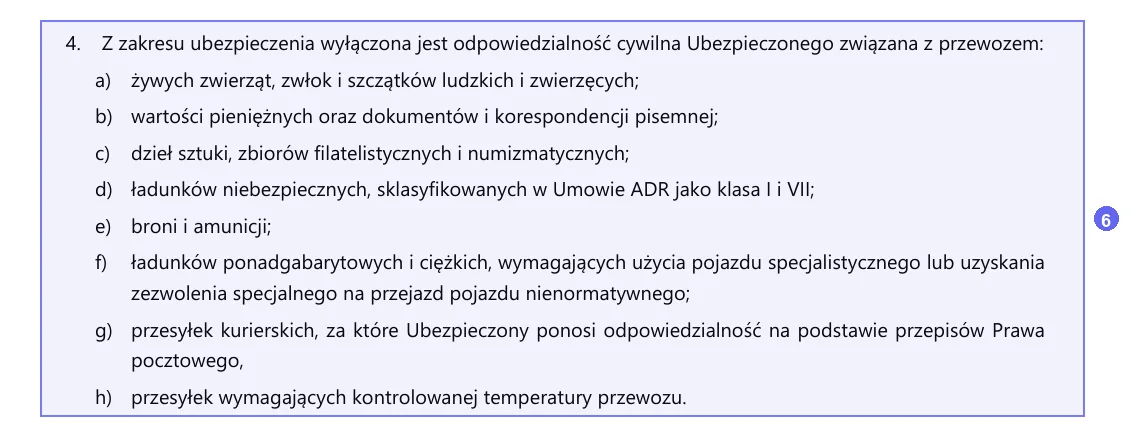
Open “§ 2. Wyłączenia odpowiedzialności Compensa TU S.A.” (exclusions of Compensa’s liability), paragraph 4. The sentence starts “Z zakresu ubezpieczenia wyłączona jest odpowiedzialność cywilna Ubezpieczonego związana z przewozem” (liability connected with the carriage of the following is excluded). This is an exclusion list, not a stamp that every cargo is in.
The list includes live animals, cash, works of art, ADR classes I and VII, weapons, oversized loads that need a special permit, courier consignments and “przesyłek wymagających kontrolowanej temperatury przewozu” (shipments that require a controlled temperature). A high sum in § 4 does not cover an item on that list unless a separate line was bought in § 1.
Watch this
Some contracts add controlled temperature as a sublimit in § 1. Others leave it only on the exclusion list. Read both places, not only the main sum.
Step 7. Official confirmation
Compensa publishes a form “Potwierdzenie zawarcia umowy OC przewoźnika” (confirmation of a carrier liability contract) on zgloszenie.compensa.pl. Open that page yourself. Enter the data Compensa uses to recognise the policy. If the data match, the confirmation appears at once and is sent by email. Otherwise a reply comes within 3 working days.
Do not confuse that form with “Potwierdzenie zawarcia umowy OC” for vehicle MTPL. Do not use a phone number that appears only in the carrier’s email. A German “Versicherungsnachweis” confirms cabotage under § 7a GüKG, but it omits the exclusion list and the haul-start condition.
Limits most often missed on Compensa policies
German cabotage sits in a separate annex, not in the main contract
Look for an “Aneks” (annex) headed “Kabotaż Niemcy” (German cabotage) with “Product_CODE: 140012003”. The annex cites § 7a Güterkraftverkehrsgesetz and the HGB, with a limit of 40 SDR per kilogram. The annex sum is “niezależna w stosunku do sumy ubezpieczenia wskazanej w umowie” (independent of the sum insured in the main contract).
No annex means no German cabotage. The sum in § 4 of the main contract does not buy that scope. The annex limits vehicles to DMC above 3.5 t.
Controlled temperature is an exclusion until you buy it in § 1
§ 2(4)(h) excludes “przesyłek wymagających kontrolowanej temperatury przewozu” (shipments that require a controlled temperature). Cover for that cargo exists only as a separate sublimit in “§ 1. Zakres przedmiotowy ubezpieczenia” (subject-matter of the insurance), usually with an ATP certificate and a working thermograph. No such line ends the check for chilled food.
“Europa” in § 13 does not include Ukraine or the CIS
§ 13(2) covers “Rzeczypospolitej Polskiej, Europy, z wyłączeniem Ukrainy oraz krajów Wspólnoty Niepodległych Państw (m.in. Białorusi, Mołdawii, Federacji Rosyjskiej)” (Poland and Europe, excluding Ukraine and the CIS, including Belarus, Moldova and the Russian Federation). A haul through those countries does not sit under the heading Europe. Compare the loading and unloading points with that sentence, not with an EU map.
The period runs from the start of the haul, not from unloading
§ 13(1) covers an event in the period only if “rozpoczęcie przewozu wstąpiło w okresie ubezpieczenia” (the haul started during the period of cover). A policy still valid on the delivery day is not enough if loading was before 00:00 in § 13. Check both booking dates.
The single sum in § 4 is not the limit for every risk
“Suma ubezpieczenia” (sum insured) in § 4 is the cap for each event. In § 1 Compensa adds sublimits, for example for a value declaration under CMR article 24, delay or legal assistance. Those figures sit inside the main sum. A PDF from the start of the period does not show how much of that limit remains.
The deductible on a carried vehicle is often higher than on other losses
In § 4 “Franszyza redukcyjna” (deductible) often has a separate line “w każdym przewożonym pojeździe” (for each vehicle carried) and another “w każdej pozostałej szkodzie” (for every other loss). On a car-transporter booking read the higher threshold. One figure on the BAG certificate does not show that split.
How to decide after you have read the policy
| Result of the check | What it means | Next step |
|---|---|---|
| Names, dates, route, sum and the exclusion list match the booking | The document fits the planned haul | Record the result and run the remaining carrier checks |
| Different name, NIP, REGON or another party on the insured list | The contract may belong to another legal entity | Hold the decision and ask for an explanation or the right document |
| The period ends before unloading, or the haul started before § 13 | The document does not cover the whole planned haul | Ask for a renewal and confirmation before loading |
| The cargo is on the § 2(4) list and the needed line in § 1 is missing | There is no basis to accept that scope | Check the full contract or obtain confirmation from Compensa |
| The § 4 sum is high, but the Kabotaż Niemcy annex is missing or DMC does not match | The real cover for this haul or this vehicle may be too low | Compare the annex and DMC class with the cargo value and escalate the decision |
| You only have a Versicherungsnachweis, or the § 2 and § 13 pages are missing | The document is incomplete | Ask for the full contract and confirmation on zgloszenie.compensa.pl |
What a PDF check does not confirm
How to read a Compensa contract is a different question from how to confirm that it is still in force. Document analysis lets you judge the declared scope. It does not give access to the current contract in the insurer’s system.
- The PDF can be old, altered or incomplete.
- A signature and a logo do not prove authenticity on their own.
- A paid premium does not prove that the scope was not later changed.
- Carrier liability cover does not confirm vehicle MTPL, a transport licence, VAT or company status.
Remember
The PDF alone does not prove that the contract was not later changed, cancelled or limited by an endorsement.
Don’t want to analyse every policy by hand?
Certica analyses an uploaded carrier liability policy in any language. It reads the insured, the period, the document type, territorial scopes, sums and named cargo categories.
Official sources
- Compensa: carrier liability confirmation formhttps://zgloszenie.compensa.pl/obsluga-polisy/oc-przewoznika
- Compensa: general conditions indexhttps://www.compensa.pl/ogolne-warunki-ubezpieczenia/
- Compensa: general conditions for road carrier liabilityhttps://www.compensa.pl/app/uploads/2024/02/OWU-OC-Przewoznika-w-krajowym-i-miedzyanrodowym-transporcie-drogowym_12.2023.pdf
- Compensa: carrier liability product cardhttps://www.compensa.pl/app/uploads/2024/02/OC-Przewoznik-KARTA_12.2023.pdf
FAQ
Can I check a Compensa carrier liability policy online by number?
Yes. Compensa has the form Potwierdzenie zawarcia umowy OC przewoźnika (confirmation of a carrier liability contract) on zgloszenie.compensa.pl. Enter the data Compensa uses to recognise the policy. Do not confuse that form with vehicle MTPL confirmation.
Is a Compensa carrier liability policy the same as vehicle MTPL?
No. Carrier liability insurance covers the carrier’s liability for the goods and the haul. Vehicle MTPL is compulsory motor insurance and, for Polish plates, is checked separately in UFG.
Where is the sum insured on a Compensa contract?
In “§ 4. Suma ubezpieczenia” (sum insured). Compensa prints one figure for each event. German cabotage has a separate sum in the annex “Kabotaż Niemcy”. The BAG certificate shows only the cabotage sum.
Which contract dates should I compare with the booking?
The dates in “§ 13. Obowiązywanie umowy” (term of the contract) must cover the whole haul. The haul must also start inside that period. Validity on the unloading day is not enough.
Is a Compensa cabotage certificate enough instead of the full contract?
No. The Versicherungsnachweis confirms cabotage under § 7a GüKG and the sum for one and for all events. It does not show the § 2(4) list, the haul-start condition or a temperature sublimit. You need the full contract and the annex to judge cargo and route.
Which lines should I check on a Compensa contract before German cabotage?
Check whether there is an annex “Kabotaż Niemcy” with code 140012003, whether the annex sum and deductible are separate from § 4, and whether the booked vehicle has DMC above 3.5 t. Then confirm the contract on zgloszenie.compensa.pl.
What is Compensa CMR insurance?
In English freight this is the cargo or CMR liability layer: cover for the carrier’s liability for goods in transit. On a Polish Compensa form the same product is titled “Umowa ubezpieczenia odpowiedzialności cywilnej przewoźnika drogowego”. Read the document the same way: insured, dates, the single sum, the exclusion list and official confirmation.