
Carrier liability policies · 9 min read
How to check a Warta carrier liability policy
On a Warta carrier liability policy, match “Ubezpieczony” (insured) to the booking and read the period from the three separate “OKRES UBEZPIECZENIA” (period of cover) rows: domestic, international and cabotage. The sum, territory and deductible sit on later pages, and cargo is in the “ŁADUNKI OBJĘTE UBEZPIECZENIEM” (cargo covered) TAK/NIE grid. A bilingual certificate does not show this; confirm the contract on the form at warta.pl.
This is an independent Certica tutorial. It was not written or approved by Warta. The document shown is not a live insurance policy.
What the document can confirm, and what it cannot
Check a Warta policy in two stages. First read the full document and compare it with the booking. If the rate, the cargo or the file looks wrong, confirm the contract on the official Warta form.
The screenshots are a Polish Warta form. Match the printed labels. Each Polish field name in this walkthrough is followed by the English meaning in brackets.
Carrier liability insurance covers liability for goods in transit. On a Warta form the product title is “UBEZPIECZENIE OC OPERATORA TRANSPORTOWEGO” (transport-operator liability insurance). It is not vehicle MTPL. Check tractor and trailer MTPL separately in UFG. A company record in KRS or CEIDG is not carrier verification.
What the first page of a Warta policy looks like
Numbers 1 to 3 on the graphic are steps 1 to 3 below. Step 4 (sum, territory, deductible) and step 5 (cargo) are on later pages of the same form. Step 6 is the parking section. Step 7 is confirmation outside the document. The standard Warta form does not list registration plates. The printed labels are in Polish. Each step quotes those words and gives the English meaning in brackets.
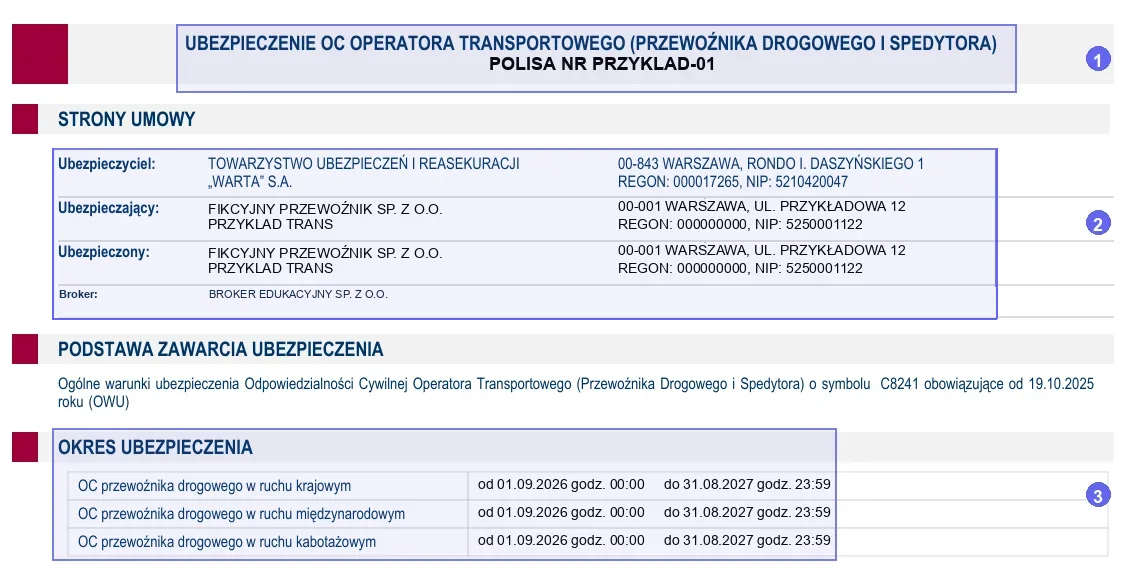
How to check a Warta carrier liability policy step by step
Step 1. Subject of insurance
On the first page find the title “UBEZPIECZENIE OC OPERATORA TRANSPORTOWEGO (PRZEWOŹNIKA DROGOWEGO I SPEDYTORA)” (transport-operator liability insurance for a road carrier and a freight forwarder). This is one Warta product. It can cover carrier liability, freight-forwarder liability, or both.
In “OKRES UBEZPIECZENIA” (period of cover) and “PRZEDMIOT I ZAKRES UBEZPIECZENIA” (subject and scope of insurance) check which rows are filled: “OC przewoźnika drogowego w ruchu krajowym” (road carrier liability in domestic traffic), “w ruchu międzynarodowym” (in international traffic), “w ruchu kabotażowym” (in cabotage). A missing row means that scope is not bought. OCS (freight-forwarder liability) alone is not enough if the company is to haul the load as the carrier.
Step 2. Insured party
Find “Ubezpieczający” (policyholder) and “Ubezpieczony” (insured). On the full policy they sit in separate rows. On the “WNIOSEK-POLISA” (application-policy) they often share one block labelled “UBEZPIECZAJĄCY, UBEZPIECZONY”. For the haul, the insured is the party whose liability must be covered. Compare the full legal name, legal form, tax ID (NIP) and address with the booking and the current company record.
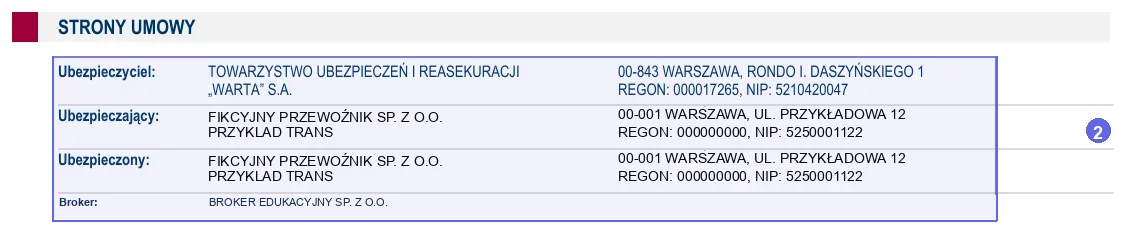
Watch this
A similar trading name is not enough. A policy issued to the owner, another group company or a former business needs an explanation before loading.
Step 3. Policy number and period
Write down “POLISA NR” (policy number) from the header. Then read “OKRES UBEZPIECZENIA” (period of cover). Warta prints a separate “od” / “do” (from / to) row for domestic, international and cabotage traffic. Do not copy one date onto all three scopes.
The dates must cover loading, transit and the planned unloading. A domestic-only policy does not cover an international haul.
Step 4. Sum, territory and deductible
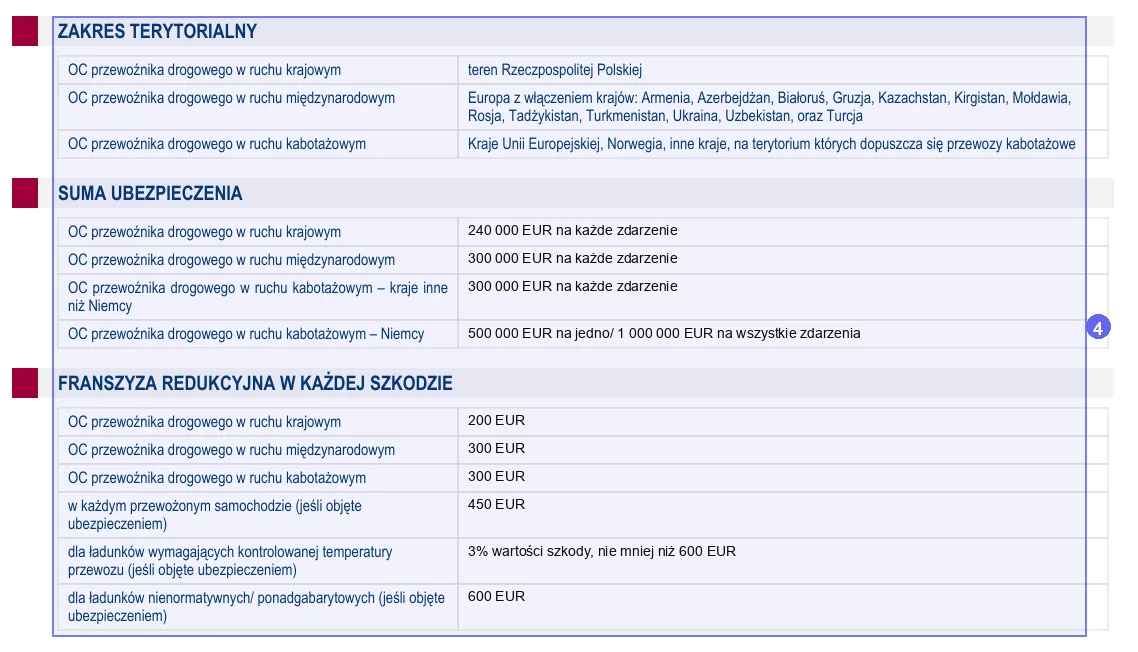
On a later page find “ZAKRES TERYTORIALNY” (territorial scope), “SUMA UBEZPIECZENIA” (sum insured) and “FRANSZYZA REDUKCYJNA W KAŻDEJ SZKODZIE” (deductible in every claim). Each scope has its own row. Do not copy the domestic sum onto international traffic.
Cabotage is split: “kraje inne niż Niemcy” (countries other than Germany) is “na każde zdarzenie” (per event). “Niemcy” (Germany) has one figure “na jedno” (for one event) and another “na wszystkie zdarzenia” (for all events). The deductible for cars and temperature-controlled cargo is separate, but only “jeśli objęte ubezpieczeniem” (if covered).
Step 5. Cargo and extensions
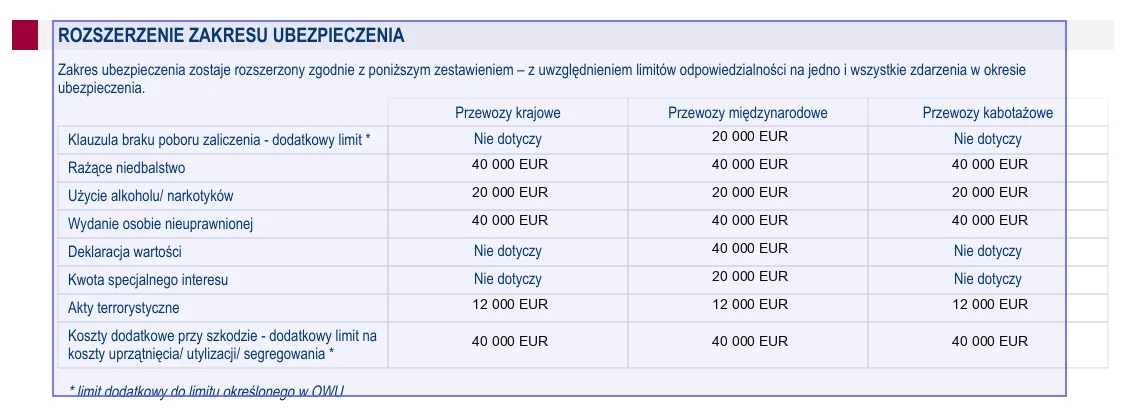
Read the table “OC PRZEWOŹNIKA – CO OBEJMUJE ZAKRES UBEZPIECZENIA” (carrier liability: what the scope includes). A mark in a column means cover. “Nie dotyczy” (does not apply) means that extension was not bought. Check the columns “Przewozy krajowe” (domestic hauls), “Przewozy międzynarodowe” (international hauls) and “Przewozy kabotażowe” (cabotage hauls) separately.
Then open “ŁADUNKI OBJĘTE UBEZPIECZENIEM” (cargo covered by the insurance). The column “Czy objęte ubezpieczeniem” (whether covered) is TAK (yes) or NIE (no). A high main sum does not cover a NIE cargo. A star marks cargo with stricter parking rules. Below the grid is “Ładunki wyłączone z ubezpieczenia” (cargo excluded from the insurance), including ADR class VII.
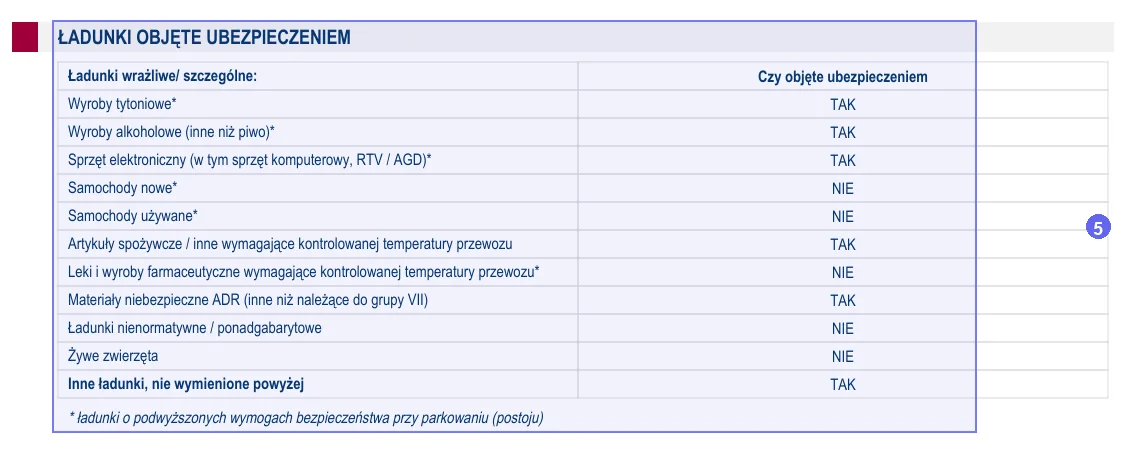
Watch this
ADR on the Warta form is “Materiały niebezpieczne ADR (inne niż należące do grupy VII)” (dangerous goods other than class VII). Class VII stays out even when that row is TAK.
Step 6. Parking places
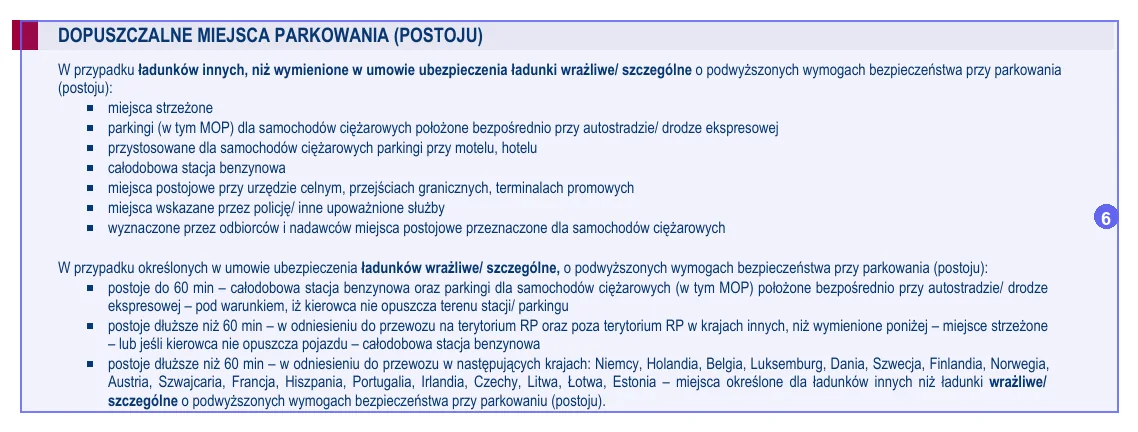
The standard Warta form does not list plates. Look for vehicle limits in “DOPUSZCZALNE MIEJSCA PARKOWANIA (POSTOJU)” (permitted parking / stopping places) and in the sensitive-cargo rules. For ordinary cargo the list includes a guarded site, an MOP (motorway service area) on a motorway, a hotel truck park, a 24-hour petrol station, a border and a ferry terminal.
For starred cargo the rule is tighter. A stop of up to 60 minutes: a petrol station or an MOP if the driver stays on site. A longer stop in Poland and outside the printed country list: a guarded place, or a petrol station if the driver stays in the vehicle. On the printed country list, including Germany and France, the ordinary-cargo places apply. Food under ATP needs a current ATP certificate.
Step 7. Official confirmation
Warta does not publish a public search for carrier liability policies by number. Open the form “Potwierdzenie polisy OC Przewoźnika” (confirmation of a carrier liability policy) on warta.pl yourself. Do not use a phone number that appears only in the carrier’s email.
The full policy usually has several pages. A “CERTYFIKAT UBEZPIECZENIOWY” (insurance certificate) confirms that a contract exists, but it omits the cargo grid, the extensions and the parking rules. Missing those pages changes the assessment of the scope.
Limits most often missed on Warta policies
German cabotage uses a different limit basis than other countries
In “SUMA UBEZPIECZENIA” (sum insured) read “OC przewoźnika drogowego w ruchu kabotażowym – kraje inne niż Niemcy” (cabotage in countries other than Germany) separately from “– Niemcy” (Germany). The first row is “na każde zdarzenie” (per event). The German row splits a figure “na jedno” (for one event) and a figure “na wszystkie zdarzenia” (for all events).
Do not treat the German limit as the limit for cabotage in France or the Netherlands. Check the country of the haul and both rows.
The delay limit changes in every column
In the scope table find the row “Opóźnienie” (delay). Domestic traffic is “podwójna kwota przewoźnego” (twice the freight). International traffic is “kwota przewoźnego” (the freight). German cabotage is “potrójna kwota przewoźnego” (three times the freight). Other cabotage countries have a separate, low limit “na jedno i wszystkie zdarzenia” (for one and all events).

“Nie dotyczy” in a column means that extension was not bought
Rows such as “Klauzula Paramount” (Paramount clause), “Klauzula braku poboru zaliczenia” (cash-on-delivery waiver), “Nierozsądny wybór osób trzecich” (unreasonable choice of third parties), “Deklaracja wartości” (declaration of value) and “Kwota specjalnego interesu” (special interest amount) can be in scope in one column and “Nie dotyczy” (does not apply) in another. A printed row does not prove cover.
The “ROZSZERZENIE ZAKRESU UBEZPIECZENIA” table uses limits for the whole period
Under the main table there is a second schedule, “ROZSZERZENIE ZAKRESU UBEZPIECZENIA” (extension of the scope of insurance). Those limits are “na jedno i wszystkie zdarzenia w okresie ubezpieczenia” (for one and all events in the period). They cover “Rażące niedbalstwo” (gross negligence), “Użycie alkoholu/ narkotyków” (use of alcohol or drugs), “Wydanie osobie nieuprawnionej” (delivery to an unauthorised person) and terrorist acts. The footnote says “limit dodatkowy do limitu określonego w OWU” (an extra limit on top of the limit in the general conditions). A PDF from the start of the period does not show how much of that limit remains.
The TAK/NIE grid decides the cargo, not the main sum
In “ŁADUNKI OBJĘTE UBEZPIECZENIEM” (cargo covered) read every row: tobacco, alcohol other than beer, electronics, new and used cars, temperature-controlled food, medicines, ADR other than class VII, oversized loads, live animals and “Inne ładunki, nie wymienione powyżej” (other cargo not listed above). NIE on your cargo ends that scope.
A star on a row means “ładunki o podwyższonych wymogach bezpieczeństwa przy parkowaniu (postoju)” (cargo with higher parking-security requirements). The ordinary MOP list is then not enough.
Warta splits ordinary parking from parking of sensitive cargo
For cargo without a star the place list is wide: a guarded site, an MOP, a hotel, a petrol station, a border, a ferry terminal. For sensitive cargo Warta splits stops of up to 60 minutes from longer stops. A longer stop outside the printed country list needs a guarded place. On that list, including Germany and France, the ordinary-cargo places apply again. Compare the cargo, the stop time and the country.
How to decide after you have read the policy
| Result of the check | What it means | Next step |
|---|---|---|
| Names, dates, route, sums and tables match the booking | The document fits the planned haul | Record the result and run the remaining carrier checks |
| Different name, tax ID or legal form of the insured | The policy may belong to another legal entity | Hold the decision and ask for an explanation or the right document |
| One of the three period rows ends before unloading | The document does not cover the whole planned haul | Ask for a renewal and confirmation before loading |
| The needed extension says “Nie dotyczy” or the cargo row is NIE | There is no basis to accept that scope | Check the full policy or obtain confirmation from Warta |
| The main sum is high, but the cabotage or delay row has a low limit | The real cover for this haul may be too low | Compare the matching row with the cargo value and escalate the decision |
| You only have a certificate, or the cargo and parking pages are missing | The document is incomplete | Ask for the full policy and confirmation on warta.pl |
What a PDF check does not confirm
How to read a Warta policy is a different question from how to confirm that it is still in force. Document analysis lets you judge the declared scope. It does not give access to the current contract in the insurer’s system.
- The PDF can be old, altered or incomplete.
- A signature and a logo do not prove authenticity on their own.
- A paid premium does not prove that the scope was not later changed.
- Carrier liability cover does not confirm vehicle MTPL, a transport licence, VAT or company status.
Remember
The PDF alone does not prove that the policy was not later changed, cancelled or limited by an endorsement.
Don’t want to analyse every policy by hand?
Certica analyses an uploaded carrier liability policy in any language. It reads the insured, the period, the document type, territorial scopes, sums and named cargo categories.
Official sources
- Warta: confirmation form for a carrier liability policyhttps://www.warta.pl/pomoc-i-obsluga/formularz-sprawdzenie-ochrony-ocp/
- Warta: help and servicing for companieshttps://www.warta.pl/dla-firmy/pomoc-i-obsluga/
- Warta: general conditions for transport-operator liability C8241https://www.warta.pl/documents/oferta_dla_firmy/OWU_OC_operatora_transportowego_C8241.pdf
- Warta: new general conditions for transport-operator liabilityhttps://www.warta.pl/korpo/artykul/mamy-juz-nowe-owu-oc-operatora-transportowego/
FAQ
Can I check a Warta carrier liability policy online by number?
There is no public Warta search for carrier liability policies by number. warta.pl has the form “Potwierdzenie polisy OC Przewoźnika” (confirmation of a carrier liability policy) and a company help page. If only the policyholder can request that confirmation, ask the carrier to obtain it.
Is a Warta carrier liability policy the same as vehicle MTPL?
No. Carrier liability insurance covers the carrier’s liability for the goods and the haul. Vehicle MTPL is compulsory motor insurance and, for Polish plates, is checked separately in UFG.
Where is the sum insured on a Warta policy?
On the full policy it is in “SUMA UBEZPIECZENIA” (sum insured), in separate rows for domestic traffic, international traffic, cabotage outside Germany and cabotage in Germany. The certificate shows one “SUMA UBEZPIECZENIA” without that split.
Which policy dates should I compare with the booking?
Each filled row in “OKRES UBEZPIECZENIA” (period of cover) must cover the whole haul in that scope: loading, transit and the planned unloading. Validity on the loading day is not enough if the policy ends before delivery.
Is a Warta certificate enough instead of the full policy?
No. The certificate confirms that a contract exists, the period, the territory and the sum. It does not show the TAK/NIE cargo grid, the extensions or the parking rules. You need the full policy to judge cargo and parking.
Which rows should I check on a Warta policy before cabotage?
Check that “ruch kabotażowy” (cabotage traffic) appears in the period and the subject, then read the German sum and the other-countries sum separately, the delay limit in the cabotage column, and the parking rule for your cargo.
What is Warta CMR insurance?
In English freight this is the cargo or CMR liability layer: cover for the carrier’s liability for goods in transit. On a Polish Warta form the same product is titled “UBEZPIECZENIE OC OPERATORA TRANSPORTOWEGO”. Read the document the same way: insured, dates, sums, territory, cargo grid and official confirmation.