
Carrier liability policies · 9 min read
How to check a UNIQA carrier liability policy
On a UNIQA carrier liability policy, match the “UBEZPIECZAJĄCY I UBEZPIECZONY” (policyholder and insured) block to the booking and check the single period in “Początek” (start) and “Koniec” (end). Read the sum from the separate block for domestic, international or German cabotage, and cargo from “TOWARY OBJĘTE OCHRONĄ” (goods covered) on the next page: it starts with exclusions. A certificate does not show this; confirm the contract on UNIQA’s form.
This is an independent Certica tutorial. It was not written or approved by UNIQA. The document shown is not a live insurance policy.
What the document can confirm, and what it cannot
Check a UNIQA policy in two stages. First read the full document and compare it with the booking. If the rate, the cargo or the file looks wrong, confirm the contract on the official UNIQA contact form.
The screenshots are a Polish UNIQA form. Match the printed labels. Each Polish field name in this walkthrough is followed by the English meaning in brackets.
Carrier liability insurance covers liability for goods in transit. On a UNIQA form the product title is “Ubezpieczenie odpowiedzialności cywilnej przewoźników w krajowym i międzynarodowym ruchu drogowym” (carrier liability insurance in domestic and international road traffic). It is not vehicle MTPL. Check tractor and trailer MTPL separately in UFG. A company record in KRS or CEIDG is not carrier verification.
What the first page of a UNIQA policy looks like
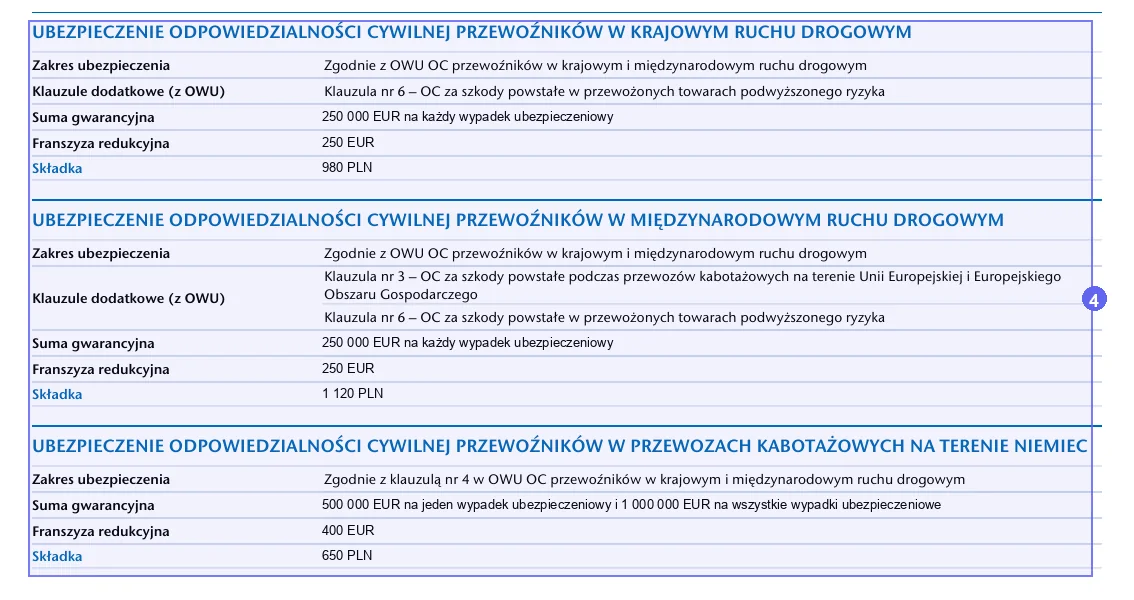
Numbers 1, 2, 3 and 5 on the graphic are the same steps below. Step 4 (the three sum and clause blocks) sits lower on the same first page. Step 6 is “TOWARY OBJĘTE OCHRONĄ” (goods covered) on the next page. Step 7 is confirmation outside the document. The standard UNIQA form does not list registration plates. The printed labels are in Polish. Each step quotes those words and gives the English meaning in brackets.
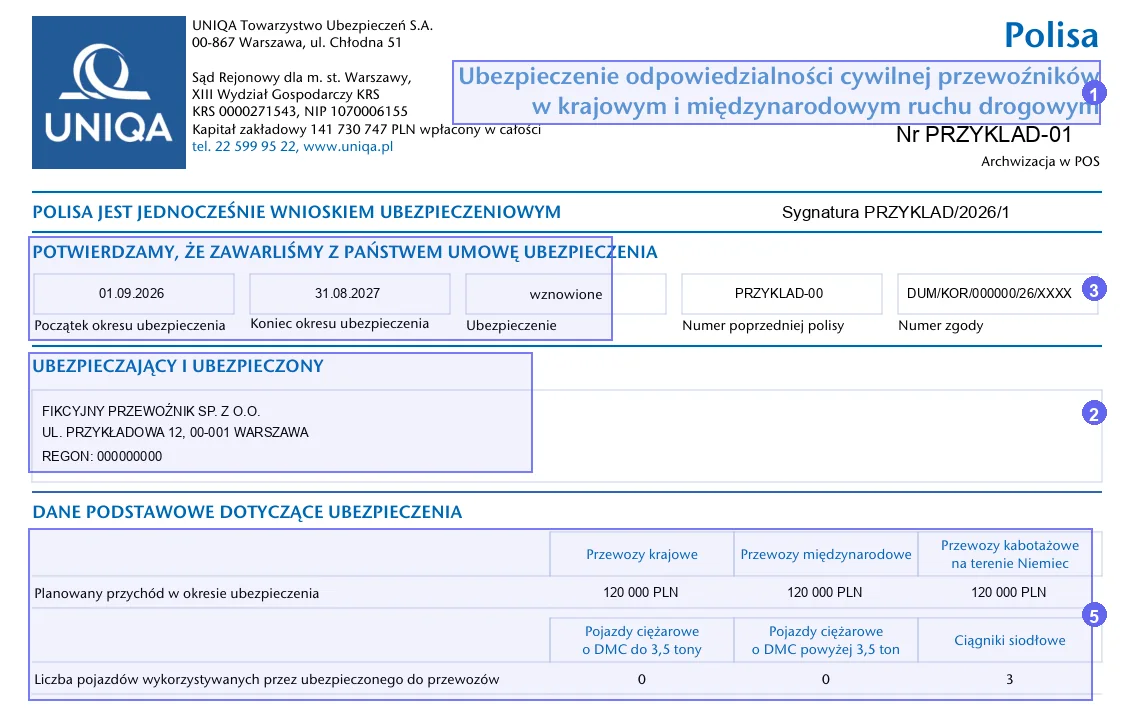
How to check a UNIQA carrier liability policy step by step
Step 1. Subject of insurance
On the first page find the title “Ubezpieczenie odpowiedzialności cywilnej przewoźników w krajowym i międzynarodowym ruchu drogowym” (carrier liability insurance in domestic and international road traffic). That is the UNIQA product.
The confirmation line sits under the header: “POTWIERDZAMY, ŻE ZAWARLIŚMY Z PAŃSTWEM UMOWĘ UBEZPIECZENIA” (we confirm that we have concluded an insurance contract with you). The form is also the application: “POLISA JEST JEDNOCZEŚNIE WNIOSKIEM UBEZPIECZENIOWYM” (the policy is also the insurance application).
Step 2. Insured party
Find the block “UBEZPIECZAJĄCY I UBEZPIECZONY” (policyholder and insured). UNIQA puts both roles in one field. Compare the full legal name, legal form, REGON and address with the booking and the current company record.

Watch this
A similar trading name is not enough. A policy issued to the owner, another group company or a former business needs an explanation before loading.
Step 3. Policy number and period
Write down the number in the header field “Nr” (number). Then read “Początek okresu ubezpieczenia” (start of the period of cover) and “Koniec okresu ubezpieczenia” (end of the period of cover). UNIQA prints one period for the whole contract, not a separate date row for each scope.
The dates must cover loading, transit and the planned unloading. The field “Ubezpieczenie” (insurance) shows “nowe” (new) or “wznowione” (renewed). On a renewal also check “Numer poprzedniej polisy” (previous policy number).
Step 4. Sum, territory and deductible
Lower on the first page sit separate blocks. Look for the headings “UBEZPIECZENIE ODPOWIEDZIALNOŚCI CYWILNEJ PRZEWOŹNIKÓW W KRAJOWYM RUCHU DROGOWYM” (carrier liability in domestic road traffic), “W MIĘDZYNARODOWYM RUCHU DROGOWYM” (in international road traffic) and “W PRZEWOZACH KABOTAŻOWYCH NA TERENIE NIEMIEC” (in cabotage on German territory). A missing block means that scope is not bought.
In each block read “Suma gwarancyjna” (sum insured), “Franszyza redukcyjna” (deductible) and “Klauzule dodatkowe (z OWU)” (additional clauses from the general conditions). Do not copy the domestic sum onto international traffic. German cabotage often has one figure “na jeden wypadek” (for one event) and another “na wszystkie wypadki” (for all events).
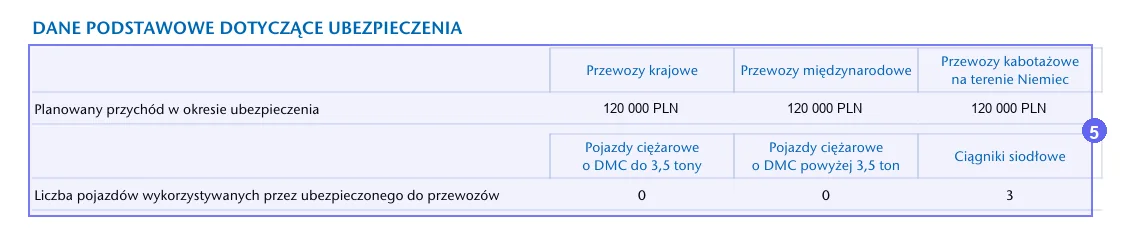
Step 5. Vehicle count by DMC class
In “DANE PODSTAWOWE DOTYCZĄCE UBEZPIECZENIA” (basic data on the insurance) find “Liczba pojazdów wykorzystywanych przez ubezpieczonego do przewozów” (number of vehicles used by the insured for carriage). UNIQA splits vehicles into “Pojazdy ciężarowe o DMC do 3,5 tony” (goods vehicles up to 3.5 t GVW), “o DMC powyżej 3,5 ton” (over 3.5 t) and “Ciągniki siodłowe” (tractor units).
Zero in a column means that class was not declared. The standard form does not list plates. Match the booked vehicle class to a non-zero column.
Step 6. Goods covered
On the next page open “TOWARY OBJĘTE OCHRONĄ” (goods covered). The sentence starts “Ochroną obejmujemy przewóz towarów różnego rodzaju z wyłączeniem” (we cover carriage of goods of various kinds excluding). This is an exclusion list, not a stamp that every cargo is in.
The list includes loads on an open vehicle without a tarpaulin (“pojazdem otwartym bez opończy”), temperature-controlled goods and ADR classes I and VII. A high sum in the domestic or international block does not cover a cargo on that list unless a separate clause was bought.

Watch this
Some policies add a second list: coal, coke, diesel, petrol, gas. Read the whole paragraph, not only the first sentence.
Step 7. Official confirmation
UNIQA does not publish a public search for carrier liability policies by number. Open the contact form on uniqa.pl yourself. Do not use a phone number that appears only in the carrier’s email.
The full policy usually has several pages. A “CERTYFIKAT UBEZPIECZENIA” (certificate of insurance) confirms that a contract exists, but it omits the goods list, the extra clauses and the vehicle counts. Missing those pages changes the assessment of the scope.
Limits most often missed on UNIQA policies
EU, German and UK cabotage sit in three different places
“Klauzula nr 3” (clause no. 3) in the international block is cabotage in the European Union and the European Economic Area. The separate block “W PRZEWOZACH KABOTAŻOWYCH NA TERENIE NIEMIEC” (cabotage on German territory) rests on “klauzula nr 4” (clause no. 4). “Klauzula nr 5” (clause no. 5) is cabotage in the United Kingdom.
The international heading alone does not buy cabotage. No clause 3 means no EU cabotage. A haul in Germany or the United Kingdom needs the matching line, not only the international sum.
“Klauzula nr 6” buys high-risk goods
Look for “Klauzula nr 6 – OC za szkody powstałe w przewożonych towarach podwyższonego ryzyka” (clause no. 6: liability for damage to high-risk goods carried). Without that line, high-risk goods stay out. Some policies also add them to the exclusion list as “towarów podwyższonego ryzyka zgodnie z definicją w OWU” (high-risk goods as defined in the general conditions).
“Klauzula nr 2” buys temperature-controlled cargo
The list “TOWARY OBJĘTE OCHRONĄ” (goods covered) excludes “towarów przewożonych w kontrolowanej temperaturze” (goods carried at a controlled temperature). Cover for that cargo is “Klauzula nr 2 – OC za szkody powstałe w towarach przewożonych w kontrolowanej temperaturze spowodowane niezachowaniem temperatury przewozu” (clause no. 2: liability for temperature-controlled goods damaged by failure to keep the required temperature). No clause 2 ends the check for chilled food.
“Na każdy wypadek” is not the same as “na jeden i na wszystkie”
In “Suma gwarancyjna” (sum insured) UNIQA writes either “na każdy wypadek ubezpieczeniowy” (for each event) or “na jeden i na wszystkie wypadki ubezpieczeniowe” (for one and for all events). The second wording wears the limit down during the period. German cabotage often splits a figure for one event and a higher figure for all events. A PDF from the start of the period does not show how much of that limit remains.
Extra clauses sit inside the main sum
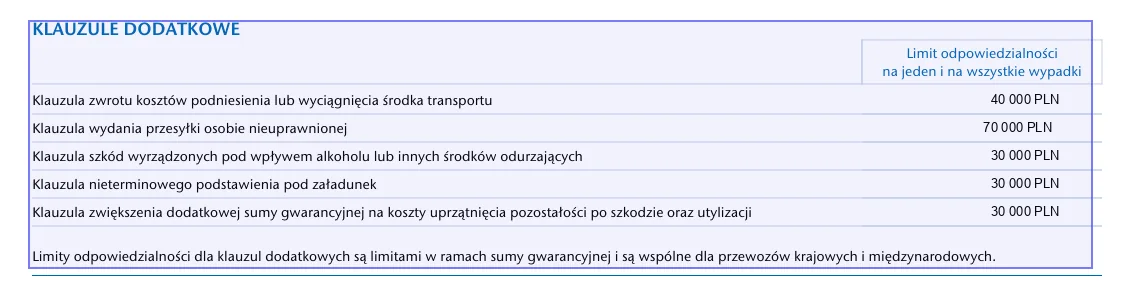
The table “KLAUZULE DODATKOWE” (additional clauses) has its own amounts, but the note says: “Limity odpowiedzialności dla klauzul dodatkowych są limitami w ramach sumy gwarancyjnej i są wspólne dla przewozów krajowych i międzynarodowych” (the limits for additional clauses sit inside the sum insured and are shared by domestic and international hauls). Those figures are not money on top of the block sum.
An open vehicle without a tarpaulin excludes cars and machinery
The goods list excludes “ładunków przewożonych pojazdem otwartym bez opończy, w tym samochodów nowych i używanych, maszyn budowlanych i rolniczych” (loads carried on an open vehicle without a tarpaulin, including new and used cars and construction and agricultural machinery). An open trailer without a sheet ends that scope even when the main sum is high.
How to decide after you have read the policy
| Result of the check | What it means | Next step |
|---|---|---|
| Names, dates, route, sums and the goods list match the booking | The document fits the planned haul | Record the result and run the remaining carrier checks |
| Different name, REGON or legal form in the insured block | The policy may belong to another legal entity | Hold the decision and ask for an explanation or the right document |
| The period ends before unloading, or the block for the route is missing | The document does not cover the whole planned haul | Ask for a renewal and confirmation before loading |
| The cargo is on the exclusion list and the needed clause is missing | There is no basis to accept that scope | Check the full policy or obtain confirmation from UNIQA |
| The main sum is high, but cabotage or the DMC class does not match | The real cover for this haul or this vehicle may be too low | Compare the matching block and vehicle column with the cargo value and escalate the decision |
| You only have a certificate, or the goods page is missing | The document is incomplete | Ask for the full policy and confirmation on uniqa.pl |
What a PDF check does not confirm
How to read a UNIQA policy is a different question from how to confirm that it is still in force. Document analysis lets you judge the declared scope. It does not give access to the current contract in the insurer’s system.
- The PDF can be old, altered or incomplete.
- A signature and a logo do not prove authenticity on their own.
- A paid premium does not prove that the scope was not later changed.
- Carrier liability cover does not confirm vehicle MTPL, a transport licence, VAT or company status.
Remember
The PDF alone does not prove that the policy was not later changed, cancelled or limited by an endorsement.
Don’t want to analyse every policy by hand?
Certica analyses an uploaded carrier liability policy in any language. It reads the insured, the period, the document type, territorial scopes, sums and named cargo categories.
Official sources
- UNIQA: contact formhttps://www.uniqa.pl/kontakt
- UNIQA: road and rail carrier liability producthttps://www.uniqa.pl/firmy-i-pracownicy/transport/ubezpieczenie-oc-przewoznika-drogowego-i-kolejowego/
- UNIQA: general conditions for carrier liabilityhttps://www.uniqa.pl/files/user_upload/OWU_OCPD_POS_2504_0823_z.pdf
- UNIQA: German cabotage conditionshttps://www.uniqa.pl/dokumenty/Uniqa_WU_Kabotaz_Niemcy_-_indeks_UK-TR-KABDE-181001.pdf
FAQ
Can I check a UNIQA carrier liability policy online by number?
There is no public UNIQA search for carrier liability policies by number. uniqa.pl has a contact form and the carrier-liability product page. If only the policyholder can request that confirmation, ask the carrier to obtain it.
Is a UNIQA carrier liability policy the same as vehicle MTPL?
No. Carrier liability insurance covers the carrier’s liability for the goods and the haul. Vehicle MTPL is compulsory motor insurance and, for Polish plates, is checked separately in UFG.
Where is the sum insured on a UNIQA policy?
On the first page, in separate blocks for domestic traffic, international traffic and cabotage on German territory. Each block has its own “Suma gwarancyjna” (sum insured). The certificate shows one sum without that split.
Which policy dates should I compare with the booking?
“Początek okresu ubezpieczenia” (start of cover) and “Koniec okresu ubezpieczenia” (end of cover) must cover the whole haul: loading, transit and the planned unloading. Validity on the loading day is not enough if the policy ends before delivery.
Is a UNIQA certificate enough instead of the full policy?
No. The certificate confirms that a contract exists, the period and the sum. It does not show “TOWARY OBJĘTE OCHRONĄ” (goods covered), clauses 2, 3, 5 and 6, or the vehicle counts by DMC class. You need the full policy to judge cargo and route.
Which lines should I check on a UNIQA policy before cabotage?
Check whether the international block has “Klauzula nr 3” (clause no. 3), whether there is a separate German cabotage block based on clause no. 4, and for a UK haul “Klauzula nr 5” (clause no. 5). Then compare that scope’s sum and deductible with the cargo value.
What is UNIQA CMR insurance?
In English freight this is the cargo or CMR liability layer: cover for the carrier’s liability for goods in transit. On a Polish UNIQA form the same product is titled “Ubezpieczenie odpowiedzialności cywilnej przewoźników w krajowym i międzynarodowym ruchu drogowym”. Read the document the same way: insured, dates, the three sum blocks, the goods list and official confirmation.