
Carrier liability policies · 9 min read
How to check a PZU carrier liability policy
On a PZU carrier liability policy, match “Ubezpieczony” (insured) to the booking, check the period in the header, and read the domestic and international “Suma ubezpieczenia” (sum insured) separately: on a table layout they sit in separate rows. Then read the full “Rodzaj przewożonych ładunków” (type of cargo carried) line: “Mienie rodzajowo różne” (goods of various kinds) does not cover cargo on the exclusion list next to it, and the tightest limits often sit in the annexes. PZU has no public search by number, so confirm the contract on the form at pzu.pl.
This is an independent Certica tutorial. It was not written or approved by PZU. The document shown is not a live insurance policy.
What the document can confirm, and what it cannot
Check a PZU policy in two stages. First read the document and compare it with the booking. If the rate, the cargo or the file looks wrong, confirm the contract through an official insurer channel.
The screenshots are a Polish PZU form. Match the printed labels. Each Polish field name in this walkthrough is followed by the English meaning in brackets.
Carrier liability insurance covers liability for goods in transit. It is not vehicle MTPL. Check tractor and trailer MTPL separately in UFG. A company record in KRS or CEIDG is not carrier verification.
What the first page of a PZU policy looks like
Numbers 1 to 5 on the graphic are the same steps in the walkthrough below. Step 6 is the vehicle list in the annex. Step 7 is confirmation outside the document. The printed labels are in the language of the form. Each step quotes those words and gives the English meaning in brackets.
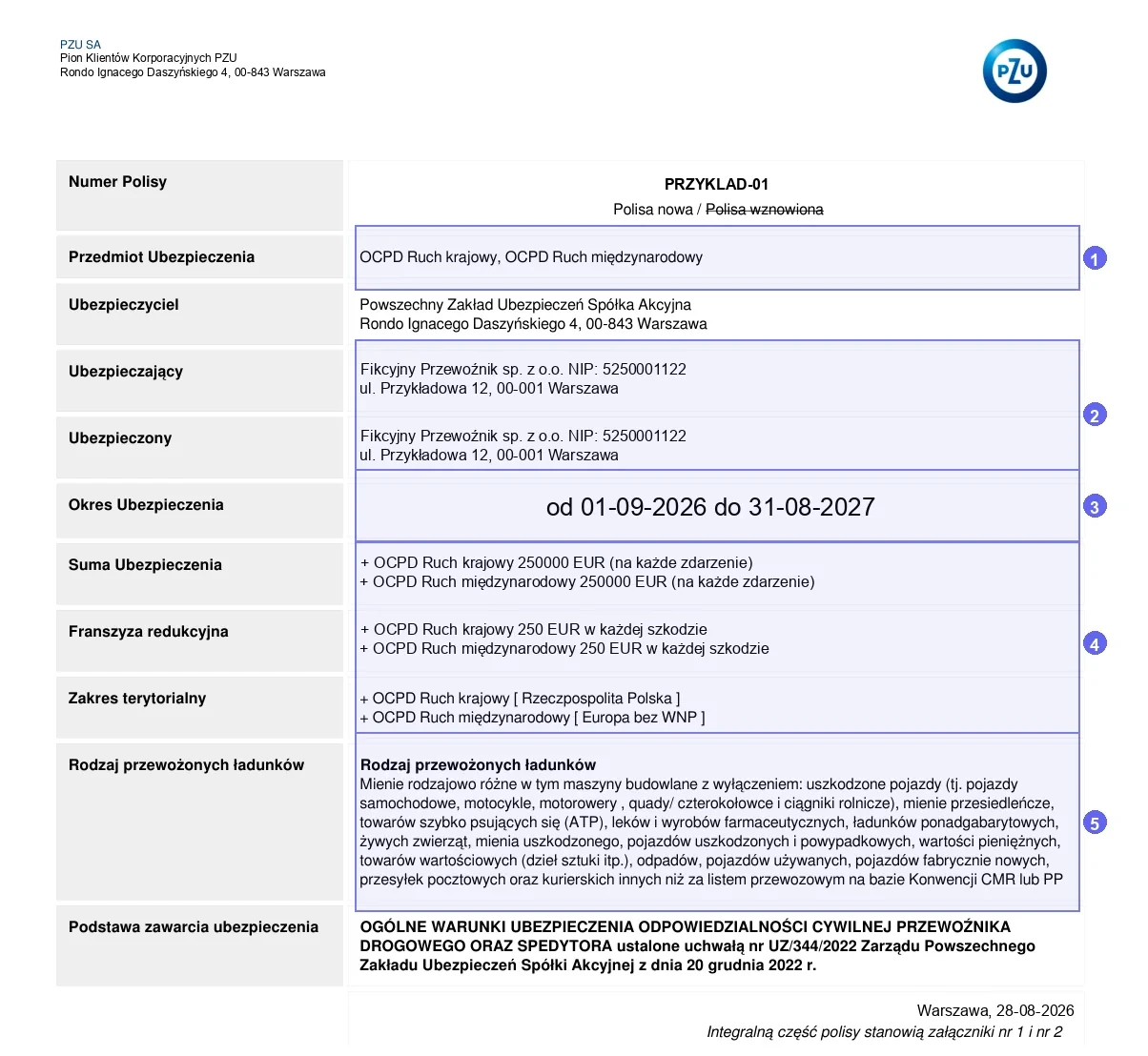
How to check a PZU carrier liability policy step by step
Step 1. Subject of insurance
On the first page find “Przedmiot ubezpieczenia” (subject of insurance). Check that the document covers road carrier liability. Check the domestic and international carrier liability sections separately.
OCS (freight-forwarder liability) is a different product. If the company is to haul the load as the carrier, do not accept OCS alone.
Step 2. Insured party
Find “Ubezpieczający” (policyholder) and “Ubezpieczony” (insured). For the haul, the insured is the party whose liability must be covered. Compare the full legal name, legal form, tax ID (NIP) and address with the booking and the current company record.

Watch this
A similar trading name is not enough. A policy issued to the owner, another group company or a former business needs an explanation before loading.
Step 3. Policy number and period
Write down the policy number from the header, next to “Numer polisy” (policy number). Then read “Okres ubezpieczenia” (period of cover). The start and end dates must cover loading, transit and the planned unloading.
Step 4. Sum, territory and deductible
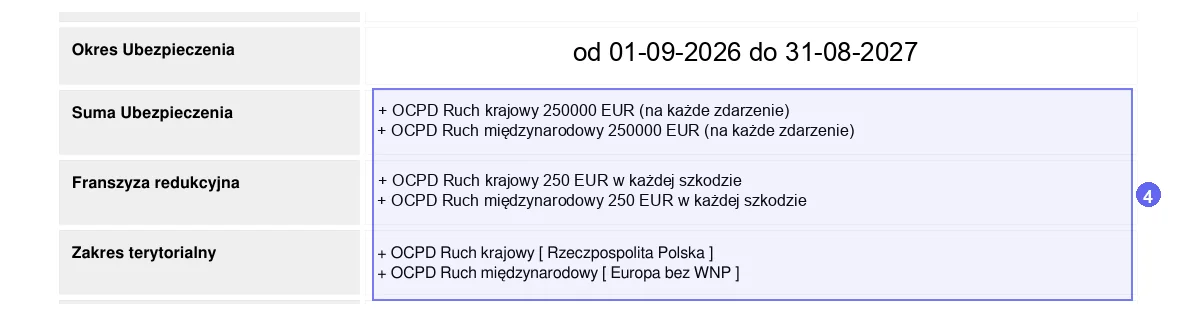
Find “Suma ubezpieczenia” (sum insured), “Franszyza redukcyjna” (deductible) and “Zakres terytorialny” (territorial scope). On the table layout, the domestic and international carrier liability sections sit in separate rows. On the numbered layout they sit in separate columns. Do not copy a sum from one scope onto the other.
“Europa bez WNP” means Europe excluding the CIS. That is not the same as cover for a domestic Polish leg. Compare the sum with the cargo value. Check sub-limits as well.
Step 5. Cargo and clauses
Read the whole row “Rodzaj przewożonych ładunków” (type of cargo carried). “Mienie rodzajowo różne” (goods of various kinds) does not mean every cargo. The words “z wyłączeniem” (excluding) start the exclusion list: ADR, perishable goods, medicines, oversized loads, live animals, waste and new, used or damaged vehicles.
If your cargo is on that list, find a separate “klauzula” (clause) that extends cover. The name of a clause on the form does not prove cover.

Watch this
Check the mark, the type of traffic, the sub-limit and the “franszyza” (deductible). Read the full wording in the annex.
Step 6. Vehicle list
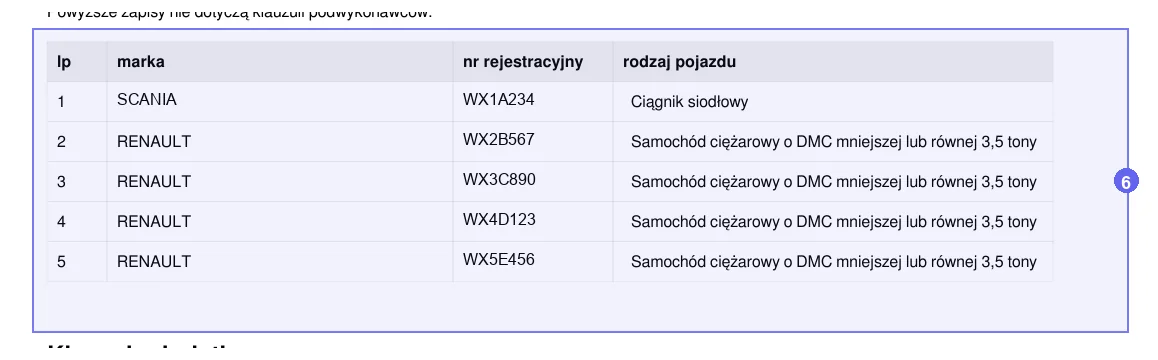
In the annex, find the vehicle table. Columns are “marka” (make), “nr rejestracyjny” (registration plate) and “rodzaj pojazdu” (vehicle type). “Ciągnik siodłowy” is a tractor unit. “DMC” is gross vehicle weight. Special conditions can limit cover to the listed plates. A newly bought, off-lease or replacement vehicle may need a notification.
Step 7. Official confirmation
PZU does not publish a public search for carrier liability policies by number. Open the confirmation form on pzu.pl yourself. Do not use a phone number that appears only in the carrier’s email.
At the bottom of the first page, read “Integralną część polisy stanowią załączniki” (the annexes form an integral part of the policy). Check which “załączniki” (annexes) are listed. A missing clause page changes the assessment of the whole scope.
Limits most often missed on PZU policies
German cabotage and cabotage in other countries are split
If the policy covers cabotage, read the German scope separately from the scope for other countries, usually the EU without Germany and excluding the UK and Norway.
The German clause splits vehicles up to 3.5 tonnes and above 3.5 tonnes. The clause for the other countries applies to vehicles above 2.5 tonnes. Check the country, the vehicle GVW and both limits.
PZU splits ordinary parking from parking with high-risk goods
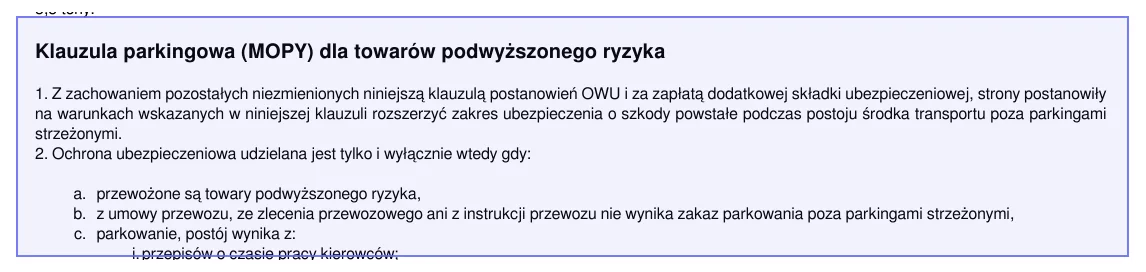
“Klauzula nr 7” (clause no. 7) covers a stop away from a “parking strzeżony” (guarded car park) when the cargo is not high-risk goods. High-risk goods need the separate heading “Klauzula parkingowa (MOPY) dla towarów podwyższonego ryzyka” (parking clause for high-risk goods at motorway service areas). “OWU” are the general conditions.
A sub-limit can apply to the whole period and shrink after a claim
Look for “limit odpowiedzialności” (limit of liability) and “suma gwarancyjna” (sum insured). In some PZU clauses the limit is set “na jeden i wszystkie wypadki” (for one and all events) in the period and “ulega zmniejszeniu” (is reduced) by each paid “odszkodowanie” (claim payment). A PDF from the start of the period does not show how much of that limit remains.

The list “ochrona nie została rozszerzona o” (cover was not extended to) matters more than a long clause list
Near the end of the annex, find the heading “Ochrona ubezpieczeniowa w ramach niniejszej polisy nie została rozszerzona o” (insurance cover under this policy was not extended to). That list is shorter than the bought clauses and easier to miss. Typical entries: Art. 24 and 26 of the CMR Convention, “składowania mienia” (storage of goods), “wydanie towaru osobie nieuprawnionej” (delivery to an unauthorised person), “szkody ukryte” (hidden damage) and “awarii agregatu chłodniczego” (refrigeration-unit failure).

Clause numbers help you find the right scope quickly
The number alone does not prove that the clause was bought. It must be marked or named in the special conditions of that policy.
| Number | Scope | What to check on this policy |
|---|---|---|
| 1 | Dangerous goods ADR | ADR classes, territory, limit and exclusions |
| 2 | Robbery | Whether domestic, international or both are marked |
| 7 | Parking away from a guarded car park | Whether the cargo is not high-risk goods |
| 26 | Loading and unloading by the carrier | The sub-limit and a separate deductible |
| 29 | Cabotage outside Germany | Countries, vehicle GVW and the combined limit |
How to decide after you have read the policy
| Result of the check | What it means | Next step |
|---|---|---|
| Names, dates, route, sums and clauses match the booking | The document fits the planned haul | Record the result and run the remaining carrier checks |
| Different name, tax ID or legal form of the insured | The policy may belong to another legal entity | Hold the decision and ask for an explanation or the right document |
| The period ends before unloading | The document does not cover the whole planned haul | Ask for a renewal and confirmation before loading |
| A clause appears on the form but is not marked | There is no basis to accept that extension | Check the annexes or obtain confirmation from PZU |
| The main sum is high, but the needed clause has a low sub-limit | The real cover for this risk may be too low | Compare the sub-limit with the cargo value and escalate the decision |
| Pages, annexes or numbering do not match | The document is incomplete | Ask for the full PDF and a current confirmation of the contract |
What a PDF check does not confirm
How to read a PZU policy is a different question from how to confirm that it is still in force. Document analysis lets you judge the declared scope. It does not give access to the current contract in the insurer’s system.
- The PDF can be old, altered or incomplete.
- A signature and a logo do not prove authenticity on their own.
- A paid premium does not prove that the scope was not later changed.
- Carrier liability cover does not confirm vehicle MTPL, a transport licence, VAT or company status.
Remember
The PDF alone does not prove that the policy was not later changed, cancelled or limited by an endorsement.
Don’t want to analyse every policy by hand?
Certica analyses an uploaded carrier liability policy in any language. It reads the insured, the period, the document type, territorial scopes, sums and named cargo categories.
Official sources
- PZU: request confirmation that a contract existshttps://www.pzu.pl/kontakt-i-pomoc/formularze-online/zamow-potwierdzenie-zawarcia-umowy
- PZU: help and contacthttps://www.pzu.pl/kontakt-i-pomoc
- PZU: general conditions for road carrier and freight forwarder liabilityhttps://www.pzu.pl/_fileserver/item/1545907
- PZU for business: road carrier and freight forwarder liability, questions and answershttps://www.pzu.pl/_fileserver/item/1555894
FAQ
Can I check a PZU carrier liability policy online by number?
There is no public PZU search for carrier liability policies by number. pzu.pl has a form to request confirmation that a contract exists, plus official contact channels. If only the policyholder can request that confirmation, ask the carrier to obtain it.
Is a PZU carrier liability policy the same as vehicle MTPL?
No. Carrier liability insurance covers the carrier’s liability for the goods and the haul. Vehicle MTPL is compulsory motor insurance and, for Polish plates, is checked separately in UFG.
Where is the sum insured on a PZU policy?
On the simple table layout it is usually in the row “Suma ubezpieczenia” (sum insured). On the numbered layout it is in the scope section, in separate columns for “ruch krajowy” (domestic traffic) and “ruch międzynarodowy” (international traffic). Extra “klauzule” (clauses) can have their own, lower sub-limits.
Which policy dates should I compare with the booking?
The period of cover should include the whole haul: loading, transit and the planned unloading. Validity on the loading day is not enough if the policy ends before delivery.
Is proof that the premium was paid enough?
Not always. It is useful evidence that a contract was concluded, but it does not show later changes, endorsements or the current scope on its own. If anything looks wrong, confirm the policy through an official PZU channel.
Which clauses should I check on a PZU carrier liability policy?
That depends on the booking. Theft and robbery, parking away from a guarded car park, ADR, high-risk goods, loading and unloading, cabotage and subcontractor liability often matter. On the form these are “klauzule”. Check the mark, the territory, the sub-limit and the “franszyza” (deductible) of each clause you need.
What is PZU CMR insurance?
In English freight this is the cargo or CMR liability layer: cover for the carrier’s liability for goods in transit. Read the document the same way: insured, dates, sums, territory, clauses and official confirmation.